.webp)
Human Chorionic Gonadotropin (HCG)
Keep the signal alive. Protect what’s important to you.

Supporting testosterone production through LH pathway signaling.
Guided by experts
Your treatment is not built from a template. Kingdom providers use lab work, health history, and ongoing check-ins to shape a protocol tailored to how your body responds over time.
Take our quiz
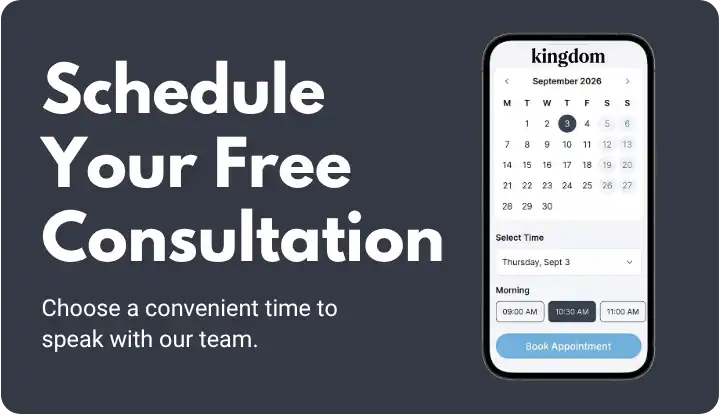
Answer a few quick questions to help us understand your goals and medical history.
Meet your provider

Meet with a specialized clinician who reviews your data and designs a strategy tailored to you.
Begin your journey

Receive your custom protocol at your doorstep with continuous clinical oversight to ensure your long-term success.
Health is a Kingdom

For every question, an expert answer.
If your question isn't here, don't worry, Ask our experts for clarity on your journey. We’re here to help.
Why is HCG used alongside testosterone therapy?
Exogenous testosterone can suppress LH release through negative feedback. HCG is sometimes used to mimic LH signaling and help maintain testicular activity during treatment.
How does HCG support testosterone production?
HCG acts as a luteinizing hormone (LH) analog, binding to LH receptors on Leydig cells in the testes. This stimulates intratesticular testosterone production through the body’s existing signaling pathways.
Can HCG help maintain fertility?
HCG supports intratesticular testosterone levels, which are necessary for spermatogenesis. This is why it is often considered when fertility preservation is part of the treatment plan.
What happens to testicular function without LH signaling?
Reduced LH activity can lead to decreased intratesticular testosterone and reduced testicular stimulation. HCG helps maintain that signaling by directly activating LH receptors.