Key Takeaways
- Enclomiphene and testosterone injections can both raise testosterone, but they work through very different mechanisms.
- Enclomiphene stimulates the body's own testosterone production by increasing LH and FSH signaling.
- Testosterone injections supply testosterone from outside the body, which can suppress natural testosterone production and sperm production.
- Enclomiphene is an oral medication, while testosterone cypionate is administered by injection on a schedule determined by your provider.
- FDA-approved testosterone cypionate products exist for certain forms of hypogonadism. Enclomiphene itself is not FDA-approved, and compounded enclomiphene products are not reviewed by the FDA for safety, effectiveness, or quality before marketing.
- Neither treatment is automatically the better choice. Your symptoms, labs, medical history, fertility plans, and treatment goals all matter.
When comparing enclomiphene vs testosterone injections, the biggest difference is not whether they can raise testosterone. Both can. The difference is how they get there.
Enclomiphene asks your body to make more testosterone of its own. Testosterone injections supply testosterone from an outside source. That one distinction changes quite a bit, including what happens to LH, FSH, natural testosterone production, sperm production, and ultimately who may be a good candidate for each treatment. It also explains why this decision can get confusing pretty quickly.
For years, men researching low testosterone mostly landed in the same place: traditional testosterone replacement therapy. Injections, gels, pellets. Pick your delivery method. Now there is another name showing up more often in the conversation.
Enclomiphene.
It has moved well beyond obscure men's health forums. Major telehealth platforms now offer enclomiphene-based treatment, and Hims currently markets an enclomiphene program for eligible men with low testosterone. That visibility has naturally created a new question: if you can stimulate your own testosterone production instead of replacing it, why wouldn't you?
Fair question. But it is not quite that simple.
An enclomiphene vs TRT decision depends on what is causing your low testosterone in the first place, whether your testes can still respond normally to hormonal signaling, whether fertility matters to you, and how your body responds to treatment.
So forget the idea that one treatment is the upgraded version of the other. They are different tools. Here's what that actually means.
How Does Each Treatment Actually Work?
The easiest way to understand TRT vs enclomiphene is to look at where each treatment enters the testosterone-production process.
Enclomiphene works upstream. Testosterone injections essentially bypass that process and provide the hormone directly.
Enclomiphene: Stimulating Your Own Testosterone Production
Your testosterone production is controlled by a communication system called the hypothalamic-pituitary-gonadal axis, or HPG axis.
The name sounds more complicated than the process. Your hypothalamus and pituitary send signals that eventually tell your testes what to do. One of those signals is luteinizing hormone, or LH. LH stimulates Leydig cells in the testes to produce testosterone. Follicle-stimulating hormone, or FSH, is also part of the system and plays an important role in sperm production. Estrogen helps regulate that loop by providing feedback to the brain.
Enclomiphene is a selective estrogen receptor modulator, or SERM. It blocks some of that estrogen feedback at the hypothalamus and pituitary, which can cause the body to release more LH and FSH.
More LH means a stronger signal to the testes to produce testosterone, assuming the testes are capable of responding. That last part is important.
Enclomiphene does not manufacture testosterone for you. It stimulates a system you already have. You can read more about how that process works in our complete enclomiphene guide. Enclomiphene is taken orally rather than injected. How often it is taken depends on the prescribed protocol, so your provider determines the dose and schedule based on your evaluation, lab results, and response to treatment.
Clinical research in men with secondary hypogonadism has shown exactly that pattern. In a 2013 study by Wiehle and colleagues, enclomiphene increased total testosterone along with LH and FSH. Testosterone gel also increased testosterone, but it suppressed LH instead.
After six weeks, men receiving the highest enclomiphene dose had a mean total testosterone level of about 604 ng/dL, compared with about 500 ng/dL in the transdermal testosterone group. The difference between those two averages was not statistically significant.
The more interesting finding was how they got there. One treatment stimulated the body's existing signaling system. The other replaced testosterone while suppressing part of that system.
Testosterone Injections: Replacing Testosterone Directly
Testosterone injections do not need the testes to make the testosterone first. They provide exogenous testosterone directly.
Testosterone cypionate is a long-acting injectable form of testosterone. After it is administered, testosterone enters circulation over time. Testosterone cypionate is not necessarily injected every day. The dose and injection schedule are determined by the prescribing provider based on the patient's needs, response, and monitoring.
The body then reacts to the higher circulating testosterone.
Through negative feedback, the hypothalamus and pituitary reduce the signals telling the testes to produce testosterone. LH and FSH can fall substantially. Natural testosterone production inside the testes decreases as a result.
That can also affect spermatogenesis.
So yes, a man using testosterone injections can have significantly higher testosterone on a blood test while his own testosterone-production system is simultaneously much less active. That is not necessarily a treatment failure. It is part of how exogenous testosterone works. But it matters a lot if fertility or preserving natural testicular function is part of the plan.
How Effective Are Enclomiphene and Testosterone Injections?
Both can raise testosterone in appropriately selected men. What the research does not give us is a simple boxing scorecard where one wins by knockout.
Most of the clinical enclomiphene research compared the medication with topical testosterone, not testosterone cypionate injections. That matters when you see neat online charts claiming that enclomiphene reaches one exact testosterone range and injections reach another.
The evidence is not that clean.
In the Wiehle study, both enclomiphene and transdermal testosterone increased total testosterone within two weeks. Enclomiphene also increased LH and FSH.
Phase III research produced a similar result. Testosterone increased across the treatment groups, but enclomiphene maintained sperm concentrations and increased LH and FSH, while testosterone gel suppressed gonadotropins and produced a marked reduction in spermatogenesis.
That tells us enclomiphene can produce a meaningful biochemical response in the population it has been studied in: men with secondary hypogonadism whose testes can still respond to pituitary signaling. Clinical trials have demonstrated increases in testosterone and preservation of sperm concentrations, but evidence establishing improvement in hypogonadal symptoms remains more limited.
Enclomiphene has a biological limitation that exogenous testosterone does not have. Your body still has to do the work.
Testosterone injections provide the hormone directly, which gives a clinician more direct control over the amount being supplied. Enclomiphene depends more heavily on your own HPG axis and testicular response.
That is one reason the enclomiphene vs TRT comparison should not come down to which one can produce the biggest number. Higher is not automatically better. Testosterone therapy is generally intended to restore testosterone to an appropriate physiologic range while improving clinically relevant symptoms, not to chase the highest possible lab result.
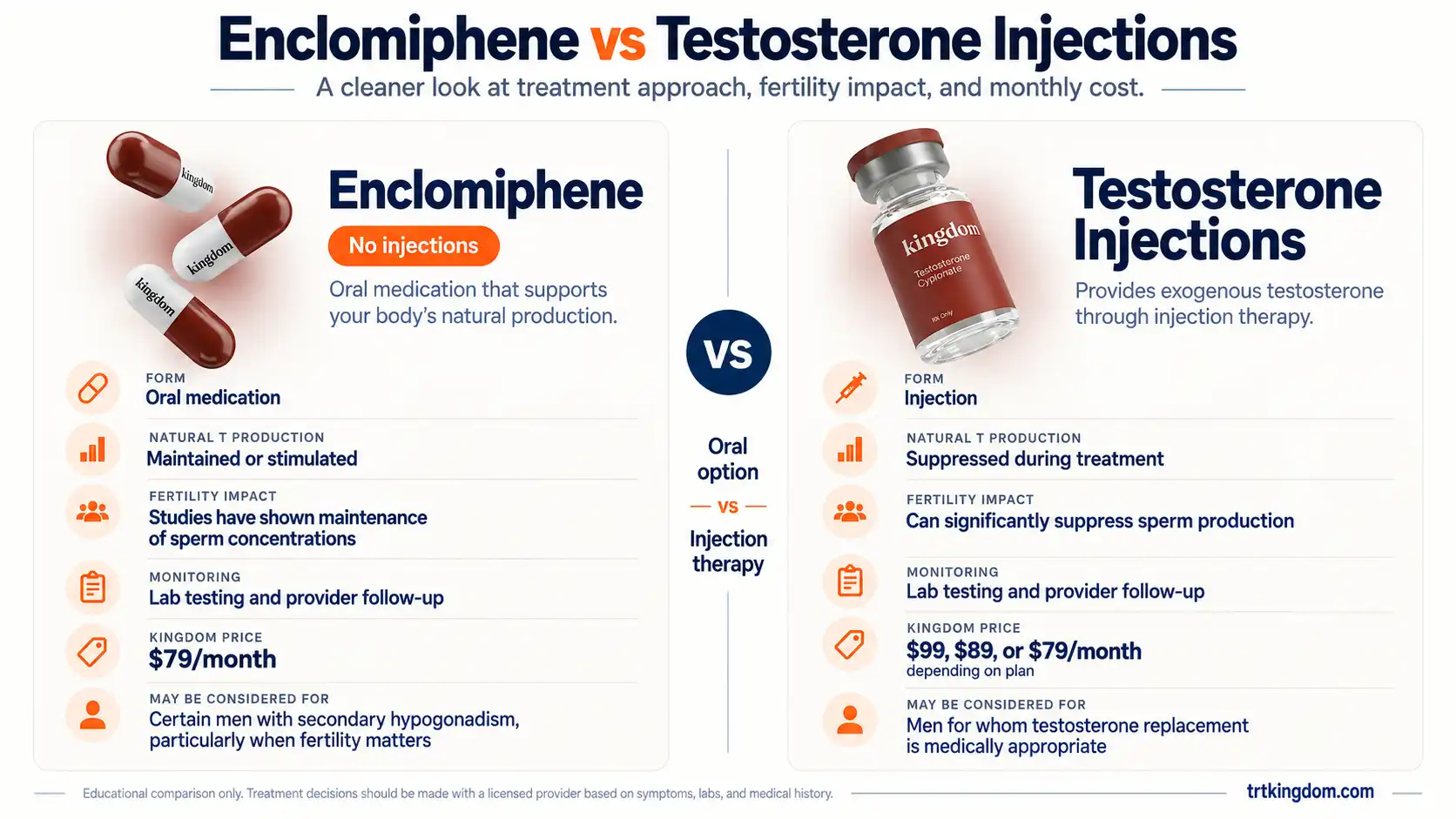
Enclomiphene vs Testosterone Injections at a Glance
The Fertility Question May Be the Biggest Difference
If you want children in the future, this deserves more than a passing mention during a testosterone consultation. It may change the treatment conversation entirely.
Enclomiphene and exogenous testosterone affect reproductive signaling in almost opposite ways.
Enclomiphene increases LH and FSH in responsive men. Those hormones are part of the system involved in both natural testosterone production and spermatogenesis. That is why fertility comes up so often when men compare enclomiphene vs testosterone.
Phase III trials in men with secondary hypogonadism found that enclomiphene maintained sperm concentrations in the normal range while raising testosterone, LH, and FSH. Testosterone gel also raised testosterone, but LH and FSH fell and sperm production dropped substantially.
A 2023 retrospective study gives us another piece of the puzzle. Men receiving enclomiphene experienced increases in total testosterone, LH, and FSH without a significant decline in semen concentration. That study is sometimes misrepresented online as a head-to-head comparison between enclomiphene and TRT. It wasn't. It compared enclomiphene with clomiphene citrate.
Testosterone replacement presents a different fertility issue because exogenous testosterone can suppress the gonadotropin signals required for normal spermatogenesis. Some men develop oligospermia, meaning very low sperm counts. This suppression is not immediate. Research using testosterone-based hormonal regimens has found that sperm counts can fall substantially over roughly two to three months in many men, although the timing and degree of suppression vary. Those studies do not predict exactly how quickly fertility will change for an individual patient using TRT.
Does that mean testosterone injections make every man permanently infertile? No.
Sperm production can recover after testosterone is discontinued, and it does in many men. But recovery varies. It can take months, sometimes longer, and predicting one individual's timeline is difficult. That is why major professional guidelines recommend against starting exogenous testosterone in men who are actively trying to conceive. Providers may also consider other tools.
HCG, for example, acts similarly to LH and may be incorporated into certain treatment plans when maintaining testicular signaling and fertility potential is part of the discussion. Kingdom offers HCG as part of a provider-guided hormone protocol.
But even here, wording matters. Adding HCG does not give anyone a fertility guarantee. Evidence supporting adjunctive strategies during TRT is still evolving, and treatment needs to account for the individual patient's reproductive goals and clinical picture. If having children matters to you, tell your provider before treatment starts. It is much easier to build fertility into the plan from day one than to discover later that nobody talked about it.
Side Effects: What Changes Between the Two?
Neither treatment comes with a side-effect exemption. And "stimulating your own testosterone" should not be confused with "risk-free."
Potential Enclomiphene Side Effects
Enclomiphene has a smaller clinical evidence base than testosterone therapy, particularly when it comes to long-term use.
Adverse effects reported in enclomiphene studies have included headache, hot flashes, nausea, gastrointestinal discomfort, fatigue, dizziness, irritability, blurred vision, and increases in estradiol. Rare thromboembolic events were also reported during clinical development, although the number of cases was small and long-term safety data remain limited.
Visual disturbances are another potential concern associated with SERM therapy and should be reported to a healthcare provider.
Estradiol deserves a quick explanation too.
Enclomiphene blocks estrogen feedback at certain receptors, but it does not simply eliminate estrogen from the body. If testosterone rises, estradiol can rise as well because some testosterone is converted to estrogen through the aromatase enzyme.
So if somebody tells you enclomiphene "doesn't affect estrogen," that is an oversimplification.
This is one reason follow-up labs matter.
Potential Testosterone Injection Side Effects
Testosterone has a much larger clinical history, so its adverse-effect profile and monitoring requirements are better established.
Possible effects include acne, oily skin, injection-site reactions, fluid retention, increased hematocrit, changes in libido, gynecomastia in some patients, suppression of LH and FSH, reduced sperm production, and decreased testicular volume.
Hematocrit is particularly important.
Testosterone therapy can increase red blood cell production, which is why hematocrit is commonly monitored before and during treatment.
The cardiovascular conversation has changed too.
In February 2025, the FDA announced class-wide testosterone labeling changes after reviewing data from the large TRAVERSE cardiovascular outcomes trial and postmarketing blood-pressure studies. The agency removed earlier boxed-warning language related to increased cardiovascular events while also requiring updated warnings related to increases in blood pressure. FDA requested additional testosterone-label updates in June 2026, including changes to language concerning age-related hypogonadism, prostate cancer risk, and benign prostatic hyperplasia.
So which has fewer side effects overall? There is no strong head-to-head evidence that lets us crown a universal winner. Enclomiphene avoids some of the suppression associated with exogenous testosterone, particularly around LH, FSH, and sperm production. Testosterone has a much deeper long-term evidence base and well-established monitoring protocols. Different advantages. Different unknowns.
What Does Each Treatment Cost?
This is where comparison shopping gets surprisingly annoying.
One clinic advertises a monthly medication price. Another bundles consultations. Another charges separately for labs. Then you discover the "starting at" price requires a year-long commitment. So look at what you are actually paying for.
At Kingdom, enclomiphene is currently $79 per month on the available 2.5-month plan. Pricing is current as of September 2026. Testosterone cypionate is currently $99 per month for the 2.5-month plan, $89 per month for the six-month plan, and $79 per month for the 12-month plan.
That means the answer to "Is enclomiphene cheaper than TRT?" is not automatically yes. At Kingdom, it depends on which testosterone plan you choose.
When comparing providers, also check whether the price includes shipping, supplies, consultations, ongoing clinical oversight, follow-up appointments, and lab work. Those extras can change what an apparently inexpensive TRT program really costs.
Kingdom accepts HSA and FSA payments for eligible expenses. Insurance coverage depends on the medication, diagnosis, insurer, and plan, and Kingdom's hormone optimization services currently operate on a cash-pay model.
Who May Be a Candidate for Enclomiphene?
Imagine your testes are capable of producing testosterone, but they are not getting enough stimulation from the hypothalamus and pituitary. Giving the system a stronger signal may help. That is the basic rationale for using enclomiphene in certain men with secondary hypogonadism.
A clinician may consider it when testosterone is low alongside low or inappropriately normal LH, when testicular function appears intact, when fertility preservation is important, or when a patient would prefer an oral treatment and wants to avoid suppressing natural LH and FSH signaling. It can also appeal to men looking for an enclomiphene alternative to TRT because they are not ready to commit to exogenous testosterone. For appropriate candidates, our enclomiphene program under licensed provider supervision offers an oral treatment option with ongoing medical oversight.
But preference does not determine candidacy. Biology does.
Enclomiphene needs a functioning pathway to stimulate. If the testes cannot adequately respond to LH, simply increasing the signal may not solve the problem.
And there is no magic testosterone number where enclomiphene suddenly becomes "the right treatment."
A total testosterone result of 280 ng/dL does not automatically mean enclomiphene. A result of 240 ng/dL does not automatically mean injections. Diagnosis requires context.
The Endocrine Society recommends diagnosing hypogonadism only when compatible signs or symptoms occur alongside unequivocally and consistently low testosterone levels, with morning testosterone measurements repeated to confirm the finding. It also recommends measuring LH and FSH to distinguish primary from secondary hypogonadism. That information tells your provider much more than one isolated number.
Who May Be a Candidate for Testosterone Injections?
Now flip the situation.
What if the issue is not that the testes are receiving a weak signal? What if the testes themselves cannot produce enough testosterone even when signaling is present?
That is where the enclomiphene vs cypionate discussion changes.
In primary hypogonadism, LH and FSH may already be elevated because the brain is effectively asking the testes to make more testosterone. If the testes cannot adequately respond, stimulating that signaling pathway further may offer limited benefit. Exogenous testosterone does not depend on that response.
A provider may therefore consider testosterone replacement for men with confirmed testosterone deficiency when direct replacement is medically appropriate, including certain men with primary hypogonadism. Fertility still matters. Because testosterone suppresses reproductive signaling, a man actively trying to conceive may need a different treatment strategy even if TRT would otherwise appear reasonable.
Lifestyle matters too, although it should come after the medical decision. Neither option is universally easier. For eligible patients prescribed injectable treatment, our testosterone cypionate protocol under medical supervision provides direct testosterone replacement with provider-guided dosing and monitoring. Some men prefer a scheduled injection regimen, while others would rather take an oral medication than store or travel with syringes, vials, and injection supplies. For someone concerned about privacy or convenience while traveling, an oral medication may also be easier to store discreetly. Ultimately, the easier option is the one that fits the prescribed treatment plan and can be followed consistently in real life.
Can You Take Enclomiphene and Testosterone Injections Together?
In this context, combination therapy means using testosterone together with another hormone-related medication as part of the same clinician-directed treatment plan. Technically, medications that stimulate reproductive signaling can be used in more complicated hormone-treatment scenarios. That does not mean everybody on TRT should start stacking medications.
Combination therapy is an area where internet advice gets ahead of the evidence pretty fast.
Clinicians may sometimes consider medications intended to maintain or restore HPG-axis signaling in men who have used exogenous testosterone, particularly when fertility is part of the picture.
HCG is probably the more familiar example. SERMs are also used by clinicians in certain male fertility and hypogonadism settings.
But there is not strong enough evidence to say that adding enclomiphene to testosterone is a standard protocol that reliably preserves fertility or prevents suppression.
The AUA/ASRM male infertility guideline notes limited studies of adjunctive strategies intended to preserve spermatogenesis while using exogenous testosterone, but the evidence is not strong enough to recommend the approach routinely. In more complicated situations like these, working with a licensed online TRT program allows a provider to evaluate fertility goals, previous treatment, hormone levels, and the broader clinical picture together.
So yes, a combined approach may come up in an individualized treatment plan. No, it is not a DIY fertility hack.
Can You Switch From Testosterone Injections to Enclomiphene?
Yes, switching treatments may be possible.
Going from one to the other is not necessarily symmetrical, though. Moving from enclomiphene to testosterone replacement is generally easier to understand conceptually. The stimulation-based treatment is discontinued or transitioned according to the clinician's plan, exogenous testosterone is introduced, and follow-up testing is used to evaluate response.
Coming off testosterone can be more complicated.
While you are using exogenous testosterone, LH and FSH are often suppressed. Your own testosterone production may be suppressed as well.
Stopping the injections does not necessarily flip everything back on immediately.
Recovery of the HPG axis and spermatogenesis varies between men. Factors such as age, duration of testosterone exposure, baseline function, and individual physiology can all play a role.
A provider may consider a SERM or another medication as part of a strategy to stimulate endogenous production after testosterone is discontinued.
You may hear this casually described online as "restarting" natural testosterone. The reality is less tidy. There is no single restart timeline or protocol that works for everyone.
Should You Try Enclomiphene Before Injections?
Sometimes that may make sense.
If a man has secondary hypogonadism, responsive testes, and a strong reason to preserve fertility, a clinician may decide that stimulating endogenous production is worth considering before exogenous testosterone.
But treatment should not become a ladder where every man is required to "fail" enclomiphene before TRT.
If enclomiphene does not produce an adequate biochemical or clinical response, that is useful information. It may lead to another look at the underlying diagnosis or a discussion about a different treatment approach.
The starting point should be your physiology, not a universal sequence copied from somebody else's protocol.
Enclomiphene vs Testosterone Injections: Which One Makes Sense for You?
After 3,000 words of comparison, you may want one clean winner.
There isn't one.
Enclomiphene may make sense for certain men with secondary hypogonadism whose testes remain capable of producing testosterone, especially when preserving fertility and natural gonadotropin signaling are priorities.
Testosterone injections offer direct hormone replacement and decades of clinical use. They may make more sense when testosterone replacement itself is medically indicated or when stimulating endogenous production is unlikely to produce an adequate response.
One works with your existing testosterone-production system.
The other supplies testosterone directly.
So the enclomiphene vs testosterone injections decision should not start with "Which one is stronger?"
It should start with better questions.
What is actually causing the low testosterone? Are LH and FSH low, normal, or elevated? Does fertility matter now or later? Age can be part of the overall clinical picture, but age alone does not determine whether enclomiphene or testosterone injections are appropriate. The cause of testosterone deficiency, repeat laboratory results, LH and FSH levels, fertility goals, medical history, and treatment response matter more to the decision. Are there medical reasons one treatment may not be appropriate? What do repeat morning labs show? And what happens when your provider puts all of those pieces together?
That is the decision.
If you're not sure which path fits your situation, you can start the intake process and speak with a licensed Kingdom provider.
Frequently Asked Questions
Is enclomiphene better than testosterone injections?
Not universally. Enclomiphene stimulates endogenous testosterone production and may be considered for certain men with secondary hypogonadism, particularly when preserving fertility matters. Testosterone injections directly replace testosterone and may be more appropriate in other clinical situations. The decision should be based on symptoms, repeat lab testing, medical history, fertility goals, and provider evaluation.
Does enclomiphene work as well as TRT?
Clinical trials have shown that enclomiphene can raise total testosterone into the normal range in some men with secondary hypogonadism. Studies comparing enclomiphene with topical testosterone found that both increased testosterone, while enclomiphene also maintained LH, FSH, and sperm concentrations. Those studies did not directly compare enclomiphene with testosterone cypionate injections, so they should not be treated as proof that the two approaches produce identical results.
Which raises testosterone more, enclomiphene or injections?
There is no single number that applies to everyone. Testosterone injections supply testosterone directly and can be adjusted by the prescribing provider, while enclomiphene relies on the body's own ability to respond to LH and FSH signaling. The goal of treatment is generally an appropriate physiologic testosterone level and clinical improvement, not simply the highest possible number.
How quickly does enclomiphene work compared with testosterone injections?
Hormonal changes can occur within the first several weeks of treatment. In one enclomiphene trial, both enclomiphene and transdermal testosterone increased testosterone within two weeks. How quickly someone notices a change in symptoms is much more variable, and research does not establish a single reliable timeline for comparing enclomiphene with testosterone cypionate injections.
Does enclomiphene really preserve fertility?
Potentially, yes. Men may still be able to conceive while taking enclomiphene, and studies in men with secondary hypogonadism found that enclomiphene maintained sperm concentrations while increasing testosterone, LH, and FSH. That makes it different from exogenous testosterone, which can suppress sperm production. However, maintaining sperm concentration is not the same as guaranteeing fertility, which depends on multiple individual factors.
Can I have children while taking testosterone?
Pregnancy may still occur while a male partner is using testosterone, but exogenous testosterone can significantly reduce sperm production and may cause azoospermia in some men. Men who are currently trying to conceive should discuss their plans with a healthcare provider before starting TRT.
Does testosterone cause testicular shrinkage?
It can. Exogenous testosterone suppresses LH signaling, which reduces intratesticular testosterone production and testicular activity. Some men notice a reduction in testicular volume during therapy, although the extent varies from person to person.
Does enclomiphene cause testicular atrophy?
Enclomiphene works by increasing LH and FSH rather than suppressing them, so it does not produce the same mechanism of testicular suppression associated with exogenous testosterone. Individual responses and adverse effects still vary.
Can you take enclomiphene and testosterone together?
A clinician may consider combination approaches in selected cases, particularly when fertility or recovery of endogenous hormone signaling is part of the treatment discussion. Evidence for routine concurrent enclomiphene and TRT is limited, however, so this should not be treated as a standard protocol or attempted without medical supervision.
Can I switch from testosterone injections to enclomiphene?
Potentially. Testosterone suppresses LH, FSH, and endogenous testosterone production, so transitioning off TRT may require time and monitoring. Whether enclomiphene is appropriate depends partly on whether the HPG axis and testes can respond adequately once exogenous testosterone is discontinued.
What happens if enclomiphene doesn't work for me?
Your provider may review the dose, adherence, symptoms, laboratory response, and original diagnosis. An inadequate response can also suggest that stimulating endogenous production is not enough for that individual, in which case another treatment approach may be discussed.
Which is safer long term?
There is not enough comparative evidence to declare one universally safer. Testosterone therapy has a much longer clinical history and more established long-term monitoring recommendations. Enclomiphene avoids some of the reproductive suppression associated with exogenous testosterone but has considerably less long-term safety data.
Which is cheaper?
At Kingdom, enclomiphene is currently $79 per month. Testosterone cypionate ranges from $99 per month on the shortest plan to $79 per month on the 12-month plan. Pricing can change, and patients should also consider what is included in the overall treatment program.
Do I need labs for enclomiphene or testosterone injections?
Yes. Symptoms alone cannot diagnose testosterone deficiency or determine which treatment is appropriate. Evaluation generally includes testosterone testing and may include LH, FSH, hematocrit, and other laboratory markers depending on the patient's history and proposed treatment.
Is enclomiphene FDA-approved for men?
No. There is currently no FDA-approved enclomiphene drug product for male hypogonadism. Compounded drugs are not FDA-approved, which means the FDA does not verify their safety, effectiveness, or quality before they are marketed.
Is testosterone cypionate FDA-approved?
FDA-approved testosterone cypionate products are available for replacement therapy in certain conditions associated with deficient or absent endogenous testosterone. Whether testosterone therapy is appropriate for an individual patient still requires medical evaluation.
This article is for educational purposes only and is not a substitute for medical advice, diagnosis, or treatment. Prescription treatment is provided only when medically appropriate following evaluation by a licensed healthcare provider. Individual results and treatment eligibility vary.