Key Takeaways
- Yes, exercise can temporarily raise testosterone by 15–40%, but the spike typically lasts only 15–60 minutes.
- Compound resistance training (squats, deadlifts, presses) and HIIT produce the strongest testosterone response.
- Long-term baseline changes come from months of consistent training. Mostly through fat loss and muscle gain, not from any single workout.
- Cardio over ~60 minutes at high intensity, done repeatedly, can lower testosterone through chronic cortisol elevation.
- The response is smaller in men over 45 and in women, and your genetics, body composition, and training history all modify it.
- If your total testosterone is below 300 ng/dL,on early-morning labs (the AUA's cutoff for low T), exercise alone is unlikely to bring you into an optimal range; it's time for labs.
Yes, working out can increase testosterone. Resistance training and high-intensity interval training (HIIT) produce a temporary spike in testosterone that typically lasts 15 to 60 minutes after exercise. Long-term consistent training also supports baseline testosterone by building muscle mass, reducing body fat, and improving sleep quality. How much you benefit depends on the type of exercise, your age, your sex, and your training history, and in some cases, exercise alone is not enough to restore optimal testosterone levels.
Millions of men search this question every month, and most aren't looking for a reason to skip the gym; they're training hard, sleeping okay, eating "clean," and still missing the drive and energy they had at 25. The fitness internet answers them with miracle workouts on one side and "just lose weight" on the other, with no nuance about what exercise actually does to your endocrine system. This guide is the definitive answer instead: the mechanism, real numbers from published studies, exact programming, and an honest look at when training isn't the problem and labs are.
How Does Exercise Actually Increase Testosterone?
Exercise raises testosterone through two mechanisms: an immediate hormonal response during hard training, and gradual body-composition and hormone-regulation changes that develop over months. The distinction is the key to everything else.
The acute response starts in your brain: hard training activates the sympathetic nervous system, signaling the hypothalamus to release gonadotropin-releasing hormone (GnRH), which tells the pituitary to release luteinizing hormone (LH) and follicle-stimulating hormone (FSH). LH signals the Leydig cells in your testes to produce testosterone; part of the post-workout bump also reflects release of stored hormone.
Kraemer and Ratamess's 2005 review established that resistance exercise reliably produces acute testosterone and growth hormone elevations, scaled to muscle mass recruited, intensity, volume, and rest intervals, which is why heavy multi-joint lifts loading fast-twitch Type II fibers outperform isolation work and Type I-dominant steady movement.
The chronic adaptation is slower: over months you build muscle and lose fat, and since fat tissue contains aromatase, the enzyme that converts testosterone into estradiol (aromatization), less fat means less testosterone converted away. Training also deepens sleep, and sleep is where your largest daily testosterone pulses are released.
So when you ask "does one workout increase testosterone?" the answer is: yes, but only briefly. The spike is temporary. The baseline shift is what lasts, and only as long as the training does.
Which Exercises Increase Testosterone the Most?
Compound lifts that load the most muscle mass: squats, deadlifts, bench presses, overhead presses, rows, and pull-ups, produce the strongest testosterone response, followed by sprint-style interval training. Here's the hierarchy, and the physiology behind it.
Compound Resistance Training
Your legs and back hold more than half your total muscle mass, which is why heavy lower-body sessions produce the largest acute response. In a 2024 randomized trial, five sets of leg press to failure raised testosterone about 3.8 nmol/L (roughly 110 ng/dL) immediately post-exercise and it was back to baseline within the hour. Research shows that heavy, high-volume resistance exercise involving large muscle groups can temporarily increase testosterone, although the size of the response varies considerably between studies.
If you want the short list, these are the top five testosterone-boosting exercises.
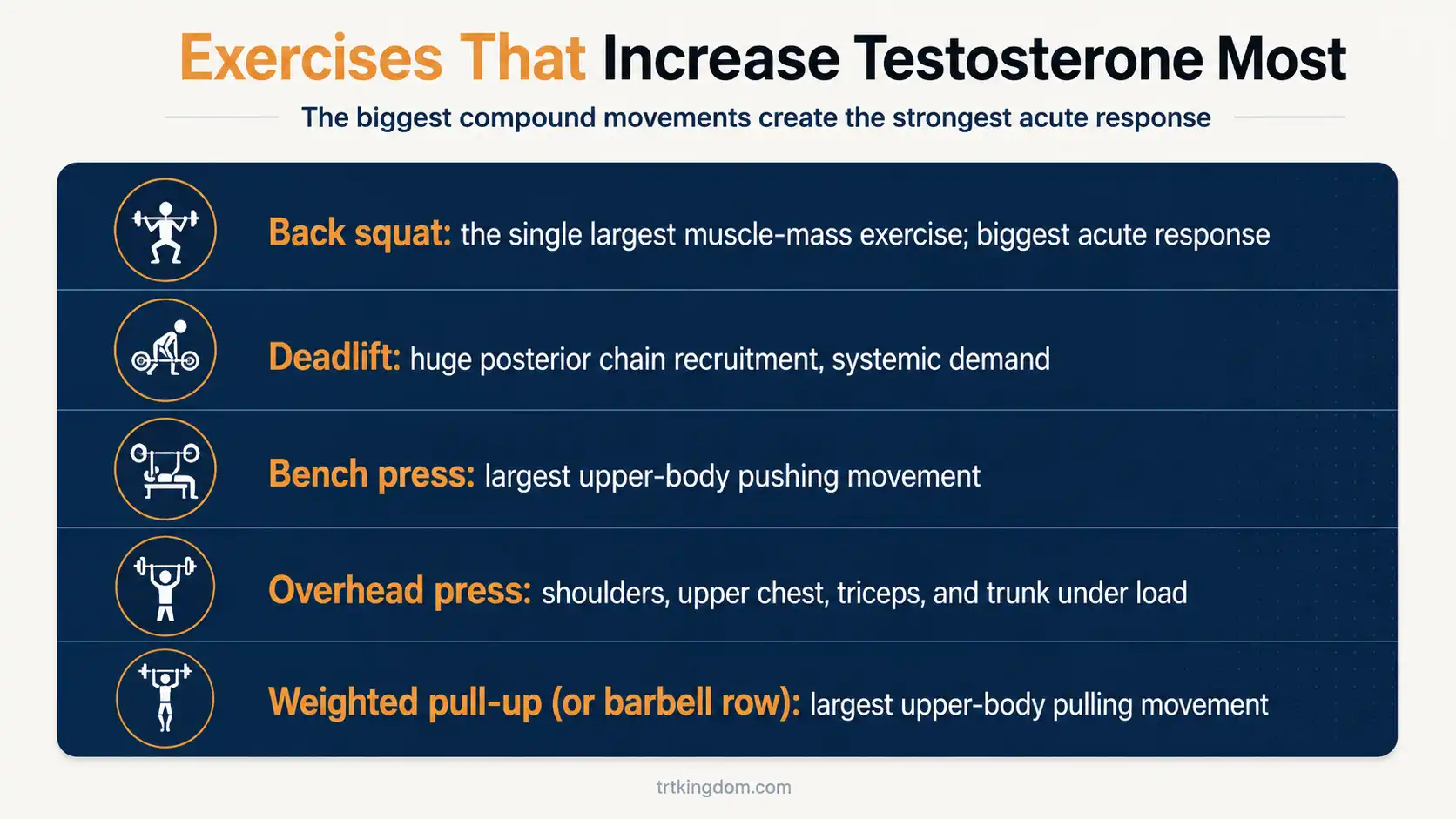
Do squats really increase testosterone? Yes. Acutely, the squat is about as good as it gets, because no other movement loads as much muscle simultaneously.
Do deadlifts and bench presses increase testosterone too? Yes, slightly less. The common thread: multiple joints, heavy loads, large muscle mass, and Type II fiber recruitment.
Isolation exercises: curls, lateral raises, leg extensions absolutely have a place in building muscle. But because they involve a fraction of the muscle mass, they generate a much weaker hormonal signal. This is the compound-versus-isolation distinction in one sentence: isolation builds the muscle it targets; compounds build the muscle they target and light up your endocrine system.
High-Intensity Interval Training (HIIT)
Does HIIT increase testosterone? Yes. Short, all-out intervals (think 6–10 rounds of 20–30 second sprints on a bike, hill, or rower, with active recovery) produce acute testosterone responses that rival lifting sessions.
Bodyweight and Calisthenics
Pull-ups, dips, push-ups, pistol squats, and hard calisthenics produce a smaller but real acute testosterone response, especially when sets are taken close to failure, which is what finally forces significant Type II fiber recruitment as you fatigue. For beginners and home-training, bodyweight work is a legitimate starting point; apply progressive overload by adding reps, slowing tempos, or adding load (a dip belt, a weighted vest), and the stimulus keeps climbing.
Steady-State Cardio
Does cardio increase testosterone? Moderate steady-state cardio, 30–45 minutes at a conversational pace, has a minimal acute effect and is essentially neutral for baseline testosterone.
Does running increase testosterone? At moderate distances, running is fine: a small, short-lived bump at most, no harm done. Cycling behaves the same way. Do it for your heart, your brain, and your body composition, all of which indirectly support healthy testosterone, but don't expect a 5K to move your labs.
How Much Does Exercise Raise Testosterone? (Real Numbers From Real Studies)
Across the literature, a hard resistance session can temporarily raise total testosterone in young men, although the size of the response varies substantially between studies, training protocols, and individuals. The increase typically peaks immediately after exercise and fades toward baseline within roughly 15–60 minutes..
First, the window. Reviews of the acute-response literature, including Riachy and colleagues' 2020 analysis, show that post-exercise testosterone elevations are short-lived. Depending on the workout and study, levels may return toward baseline within about 30–60 minutes, and some studies have even reported a slight dip below baseline afterward. So when someone asks, "Can exercise raise testosterone by 20%?" Acutely, absolutely, especially from a heavy leg day. Resting (baseline) testosterone, the number on your blood panel, is a different question.
Second, free versus total testosterone. Most of your circulating testosterone is bound to proteins, primarily sex hormone-binding globulin (SHBG), and is biologically inactive.Only a small fraction circulates completely unbound as free testosterone, while free testosterone plus the more loosely albumin-bound fraction is often described as bioavailable testosterone.
Resistance exercise can temporarily increase free testosterone, although the size of that response varies by workout and individual. SHBG also matters because it influences how much of your total testosterone circulates in the free fraction. That is why two men with similar total testosterone levels can still have different free testosterone levels, and why clinicians sometimes look beyond total T when evaluating androgen status.
Third, and this is where most fitness content goes quiet, the long-term data is more modest than the hype. A 2021 systematic review and meta-analysis examined exercise training in insufficiently active men and found a negligible overall effect on resting total testosterone. In other words, getting consistent with training does not appear to reliably push baseline testosterone higher in otherwise healthy men.
Body composition is a different part of the picture. In men carrying excess body fat, weight loss and improved metabolic health can be associated with higher testosterone levels, partly because adipose tissue influences hormone metabolism, including aromatase activity. If you're already lean and eugonadal, though, training is far more valuable for supporting overall health and body composition than for producing a dramatic rise in your baseline testosterone.
Realistic expectations: meaningful baseline change through body composition generally takes 6–12 months of consistent training, and the men who see the biggest movement are those who lose the most fat. No single workout meaningfully changes your baseline. Months of consistent training, especially when it leads to fat loss, can.fcd
Exercise Types Compared
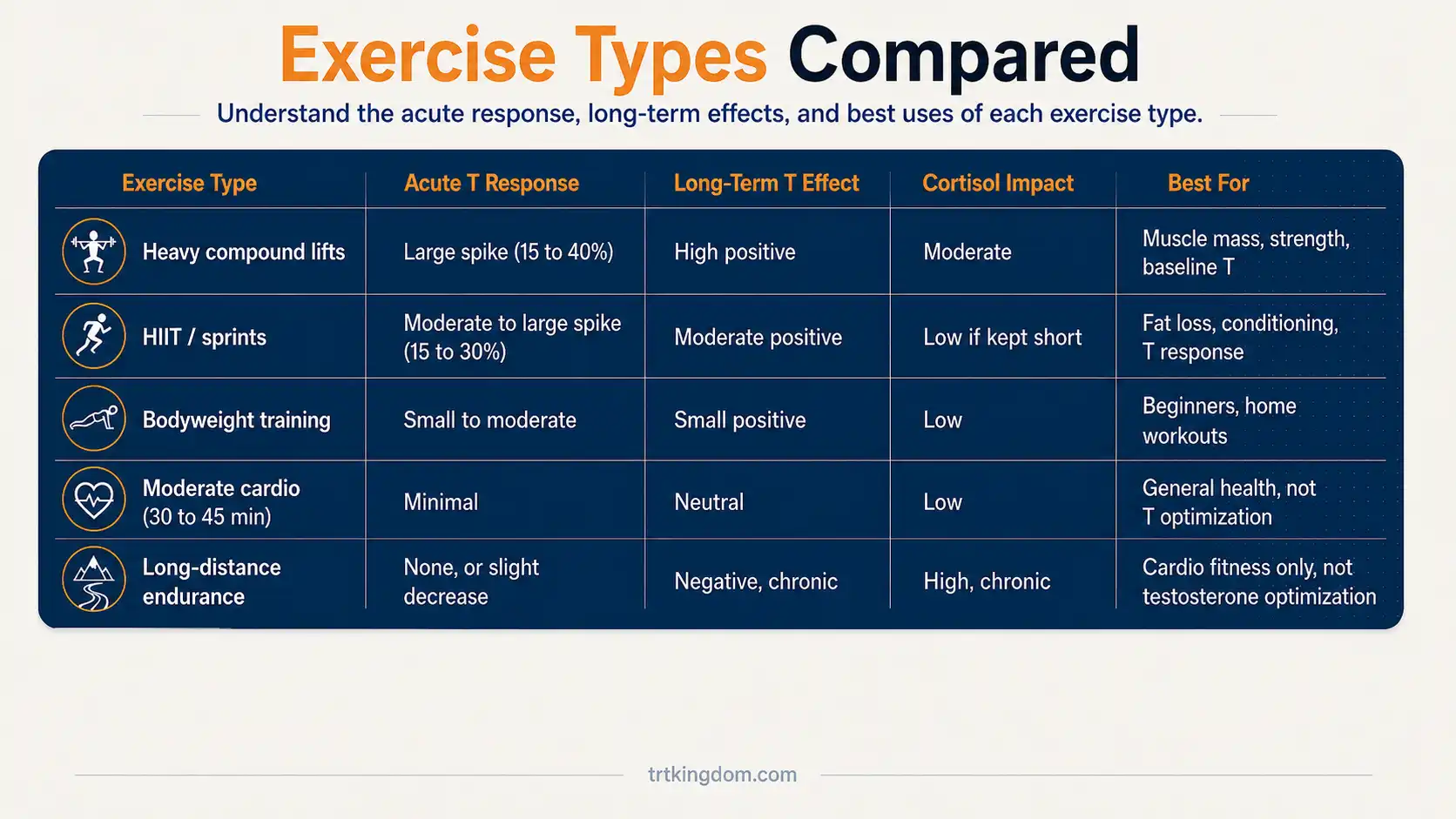
The takeaway from the table: if testosterone is the goal, resistance training is your base, short hard conditioning is your supplement, and long endurance work is a tool you use deliberately; not a default.
How Long, How Often, and How Hard? (Programming for Testosterone)
For testosterone, the evidence points to 3–4 training sessions per week, 45–60 minutes each, built around compound lifts in the 6–12 rep range with roughly two minutes of rest between sets.
Here's how each variable moves the needle.
Frequency. Three to four hard sessions per week is the sweet spot: enough volume to drive adaptation, enough recovery days to keep cortisol in check. Two sessions per week maintains what you have; six or seven hard sessions per week is where recovery debt, and the cortisol problem, usually starts for men over 35.
Sets, reps, and load. The protocols used in the acute-hormone research generally look like 3–5 sets of 6–12 repetitions at 70–85% of your one-rep max (1RM) on compound lifts. That range is heavy enough to recruit Type II fibers in serious numbers while leaving enough reps in the tank to accumulate volume. Should you lift heavy or light? Moderately heavy wins; maximal singles spike nervous-system fatigue without adding hormonal benefit, while light weight for high reps is a weak stimulus until you approach failure.
Rest intervals. Around 120 seconds between hard compound sets is the practical recommendation. Very short rest (30–60 seconds) turns your session into an extended cortisol stress test: testosterone response blunts, performance drops, and the quality of your next set suffers. Longer rests preserve both the acute hormonal response and the training stimulus.
Volume versus intensity. Both matter, and progressive overload, gradually adding weight, reps, or sets over months beats any single "hormone-optimized" session. Chasing volume past your recovery capacity is the classic mistake, and it hands you directly to the next section.
Workout splits. The best split is the one you recover from. Three practical options:
- Full body, 3×/week: best for beginners and men 40+ who need more recovery between sessions
- Upper/lower, 4×/week: the balanced middle ground for most trainees
- Push/pull/legs, 5–6×/week: advanced lifters with young recovery systems and disciplined sleep
Is 45 minutes enough? Yes. 45–60 minutes is the sweet spot for hormone-friendly training. Beyond roughly 75–90 minutes of hard work, cortisol levels climb and quality declines.
Does exercising twice a day increase testosterone? No, it mostly multiplies stress for no added hormonal benefit.
Do drop sets and supersets increase testosterone? They raise metabolic stress and can be useful tools in moderation, but the data doesn't support building your program around them for hormonal reasons.
Time of day. Your testosterone is naturally highest in the morning, but research doesn't show a meaningful long-term hormonal advantage to training at any particular clock time. Train when you can train consistently.
The Cortisol Problem: When Working Out Actually LOWERS Testosterone
Yes, the wrong training balance can work against your testosterone. The concern isn't normal cardio or the occasional brutal workout. It's chronically high training loads combined with too little fuel and inadequate recovery, conditions that can suppress reproductive signaling and lower resting testosterone.
That distinction matters because testosterone isn't regulated in isolation. The hypothalamus and pituitary control signals that ultimately tell the testes how much testosterone to produce, and sustained physiological stress or low energy availability can disrupt that system. Cortisol may be part of that stress response, but the hormonal picture is more complicated than simply “cortisol up, testosterone down.”
The clearest example is what researcher Anthony Hackney termed the exercise-hypogonadal male condition. Studies of chronically endurance-trained men have reported resting free and total testosterone at roughly 50–85% of levels seen in comparable sedentary men, without the rise in LH you would expect if the testes themselves were the primary problem. In other words, the pattern points toward altered signaling higher up the reproductive axis rather than straightforward testicular failure.
A related issue is RED-S, or Relative Energy Deficiency in Sport. When training demands consistently exceed the energy coming in, the body can downregulate functions that aren't essential for immediate survival, including reproductive function. In men, low energy availability has been associated with lower testosterone and functional hypogonadotropic hypogonadism, meaning testosterone is low while LH may also be low or inappropriately normal.
And this isn't limited to elite marathoners. Any athlete who combines a heavy training load with persistent under-fueling can create the same basic problem.
So how much cardio is too much? There is no research-backed cutoff where 59 minutes is fine and 61 minutes tanks testosterone. Risk appears to come from the combination of high training volume, insufficient energy intake and inadequate recovery over time, particularly in endurance athletes.
Signs your training is hurting your hormones rather than helping:
- Persistent fatigue that sleep doesn't fix
- Libido that quietly disappeared over a training block
- Strength plateaus or regression despite effort
- Poor sleep, elevated resting heart rate, frequent illness
- Irritability, dread of training, motivation collapse
Overtraining syndrome is real, measurable, and hormonal at its core. The fix is rarely a better program; it's less volume, more food, and more sleep.
When Exercise Is Not Enough
Some men will not restore normal testosterone through exercise alone. The American Urological Association uses a total testosterone level below 300 ng/dL as a reasonable cutoff supporting testosterone deficiency, but diagnosis requires more than one low number: two separate early-morning measurements plus compatible symptoms or signs.
The Endocrine Society similarly recommends diagnosing hypogonadism only when symptoms are accompanied by unequivocally and consistently low testosterone levels confirmed with repeat morning testing. For assays standardized to the CDC reference method, its guideline cites 264 ng/dL as the lower limit of the harmonized reference range in healthy young men.
Exercise, sleep, weight loss, and better nutrition can improve testosterone when reversible lifestyle factors are contributing. But if levels remain consistently low despite addressing those factors, especially in a lean, active man, simply training harder is unlikely to solve the underlying problem. That is when a proper clinical evaluation matters.
The signs exercise isn't enough look like this: libido that hasn't responded to better sleep and harder training, fatigue that survives your deload week, brain fog that makes work harder than it should be, and strength or muscle that keeps sliding despite doing everything right. If you've been consistent for 6–12 months: training 3–4 times weekly, sleeping 7–9 hours, eating adequately, managing alcohol, and you still feel like a passenger in your own body, the answer isn't another program. It's a blood draw.
The labs that actually matter: total testosterone, free testosterone, LH, FSH, estradiol, and SHBG (your provider may add a CBC and, if you're 50+, a PSA). Draw them in the morning, when testosterone peaks.
Those six markers tell a story:
- Low LH/FSH alongside low testosterone points to secondary hypogonadism; a signaling problem at the pituitary, sometimes traceable to training stress, under-fueling, or sleep debt.
- High LH/FSH with low testosterone points to primary hypogonadism; a testicular problem no squat rack fixes. And since SHBG determines how much of your total T is actually usable, free testosterone often explains symptoms better than the total number. For context on where you fall, it helps to see what normal testosterone levels look like at your age; the healthy range shifts decade by decade.
Here's the perspective worth sitting with: Jay Cutler built one of the greatest physiques in the history of bodybuilding, and even at that level, surrounded by the best training, food, and recovery on earth, hormone management was medical work, guided by physicians, not something effort alone handled. His point in co-founding TRT Kingdom is exactly that: if the most elite bodybuilders on the planet need medical supervision for their hormones, the average man with a 300 ng/dL lab result deserves a proper workup, not just a harder program.
If your labs confirm what your symptoms have been saying, modern treatment looks far better than the clinic stereotype your father remembers. A medically supervised TRT program starts with comprehensive labs, a licensed provider who actually reviews them, and a protocol matched to your numbers and goals; for many men, that's testosterone cypionate under provider supervision, the most widely prescribed injectable in the U.S. If you want to preserve fertility or avoid injections entirely, there's an oral option that raises natural testosterone without injections; enclomiphene stimulates your body's own production while preserving sperm output.
How do you decide between more optimization and medical evaluation? Simple triage: if you're overweight, under-trained, under-slept, or drinking weekly, lifestyle first. If you're already doing those things and still symptomatic with suboptimal labs, stop white-knuckling it.
Does Age Change the Testosterone Response to Exercise?
Exercise still raises testosterone at every age, but the size of the acute response shrinks over time, and the winning strategy shifts from chasing post-workout spikes to defending your baseline.
Men in Their 20s and 30s: The Largest Response
Young men have both the highest natural testosterone and the largest acute training response; this is the window of maximum anabolic opportunity. The honest advice for this group is boring: you don't need hormone tricks, you need a base. Build muscle now because the lean mass and training competency you establish in your 20s and 30s are the foundation your 50-year-old self will stand on. The biggest testosterone mistakes at this age are junk volume (six hard sessions weekly on five hours of sleep), aggressive alcohol intake, and treating recovery as optional.
Men in Their 40s: Meaningful but Smaller
Does working out increase testosterone after 40? Yes, the acute spike is smaller than at 25 but still very much present, and baseline defense becomes the real game. Total testosterone drifts down roughly 1% per year from your 40s onward, which makes training less optional, not more. Practically: 3–4 sessions per week, full-body or upper/lower splits, 48–72 hours between hard sessions for the same muscles, and a hard look at sleep and alcohol, both now cost more than they used to.
Men in Their 50s: Baseline Over Spikes
At 50+, the acute post-workout spike matters less than the chronic adaptation: muscle mass, body fat, insulin sensitivity, and sleep. Resistance training 2–3 times per week minimum is non-negotiable; sarcopenia (age-related muscle loss) accelerates in this decade, and muscle is your most metabolically protective tissue. Prioritize protein at every meal, keep conditioning moderate, and get labs if symptoms show up (more on that below). This is also the decade where knowing your numbers (not guessing) starts to matter, since "normal for 55" spans a wide range.
Men 60 and Older: Train for the Kingdom You Keep
Does exercise raise testosterone in men over 60? Yes, older men absolutely retain both acute responses and, more importantly, the ability to build and preserve muscle. The focus shifts to maintenance: two full-body resistance sessions per week, basic compounds at manageable loads, balance and gait work. The goal at 60+ isn't a 20% post-workout spike; it's keeping the muscle, mobility, and independence that keep your whole hormonal and metabolic system running. Resistance training in older men is arguably the single highest-return health intervention available, hormones included.
Do Women Get a Testosterone Boost From Exercise?
Resistance training can produce a temporary testosterone response in women, although the size and consistency of that response vary between studies. Heavy resistance exercise involving large muscle groups appears more likely to produce an acute hormonal response, but that short-lived increase is not considered the main reason resistance training builds muscle or strength.
Women can build substantial muscle and strength through progressive resistance training even though their circulating testosterone levels remain far below those typically seen in men. Lifting weights does not push female testosterone into the male range, and chasing a post-workout hormone spike is not necessary for making progress.
Where exercise matters more is over the long term. Resistance training helps preserve muscle and bone, while regular exercise supports body composition, insulin sensitivity, cardiovascular health, and physical function. These benefits become especially important through perimenopause, menopause, and healthy aging.
Persistently elevated testosterone in women is a different issue. Polycystic ovary syndrome (PCOS) is a common cause of androgen excess in reproductive-age women, although medications and certain adrenal, ovarian, or other endocrine conditions can also contribute. Women experiencing persistent hormone-related symptoms should be evaluated by a qualified clinician. In appropriate cases, a provider may also discuss options such as supervised testosterone therapy for women based on symptoms, medical history, and lab results.
What Else Affects the Testosterone Response to Exercise?
Exercise is one lever on a board full of them. These four factors decide whether your training converts into better hormone numbers or just better fitness.
Sleep (7–9 Hours)
Your largest daily testosterone pulses are released during deep sleep, and the research here is unforgiving: in a landmark University of Chicago study published in JAMA, a single week of 5-hour nights cut testosterone by 10–15% in healthy young men. Sleep restriction raises cortisol, blunts recovery, and quietly unravels everything your training stimulus was supposed to build. Seven to nine hours is not self-care fluff; it's the mechanism by which acute spikes become baseline gains.
Nutrition (Enough Calories, Enough Protein, Enough Fat)
Chronic under-fueling is the fastest way to train hard and still suppress testosterone; RED-S in men is usually a calories problem before it's anything else. Practical targets for hard-training men: adequate energy (a modest deficit at most if cutting), roughly 0.7–1 gram of protein per pound of body weight daily, and dietary fat kept around 20–35% of calories; very-low-fat diets are consistently associated with lower testosterone.
Do carbs before or after a workout affect testosterone? Fueling hard sessions with carbs blunts the cortisol response, which protects your T:C ratio; it's a helpful practice, not a magic switch.
Is fasted training bad for testosterone? An occasional fasted session is fine; chronic under-fueling is the actual threat.
Does creatine affect testosterone? Not directly, but it supports training quality and strength, which support everything else.
And protein timing? Total daily intake matters far more than the clock.
Stress Outside the Gym
Your body doesn't distinguish between a brutal work week and a brutal leg week; it all lands on the same HPA axis. A man training four days per week under chronic work or life stress is stacking two cortisol sources on one recovery budget. Walks, sunlight, genuine days off, and anything that activates parasympathetic recovery aren't soft, they're the other half of the training stimulus.
Alcohol
Heavy and frequent drinking lowers testosterone through direct effects on the testes and on liver metabolism of hormones. Occasional moderate drinking has a much smaller effect, but if you're chasing optimization, frequency is the variable to cut first; the weekly pattern matters more than any single night.
me.
The bottom line: training is one of the best things you can do for your testosterone, and every man should be doing it. But it's a lever, not a cure. Lift compound, sprint occasionally, sleep like it's your job, eat enough, and know your numbers. If your numbers need a physician, talk to a licensed provider; labs are included, plans start at $79/month, and you'll get straight answers about where you stand.
FAQ
How long does the testosterone spike last after a workout?
Usually less than an hour. Testosterone can rise immediately after hard resistance training, then return toward baseline within roughly 15–60 minutes.
What time of day is best to work out for testosterone?
Morning testosterone is naturally higher, but there is no meaningful long-term advantage to morning versus evening training. Consistency matters more.
Do squats really increase testosterone?
Yes, temporarily. Squats and other large-muscle resistance exercises can produce an acute testosterone rise, but there is no guaranteed percentage or proven “best” exercise.
Does cardio lower testosterone?
Normal cardio does not. Very high endurance loads combined with under-fueling and poor recovery can contribute to lower resting testosterone in some men.
Does working out increase testosterone after 40?
It can create a short-term rise, but exercise does not reliably increase baseline testosterone. Its bigger benefits are muscle, strength, body composition, and metabolic health.
Do women get a testosterone boost from lifting?
Sometimes. Resistance training can temporarily raise testosterone in women, but the response is smaller and less consistent than in men.
Why is my testosterone low even though I exercise?
Exercise is only one factor. Low testosterone can also be linked to under-fueling, obesity, medications, sleep problems, pituitary issues, or testicular dysfunction.
What labs should I get before considering TRT?
Start with two early-morning total testosterone tests. Depending on the results, your provider may also check free T, SHBG, LH, FSH, prolactin, estradiol, and other markers.
When should I consider TRT instead of exercising more?
When symptoms persist and repeat morning testing confirms consistently low testosterone. The AUA uses below 300 ng/dL as a reasonable cutoff supporting diagnosis.
This article is for educational purposes and does not constitute medical advice. Individual results vary; treatment decisions should be made with a licensed provider.