Key Takeaways
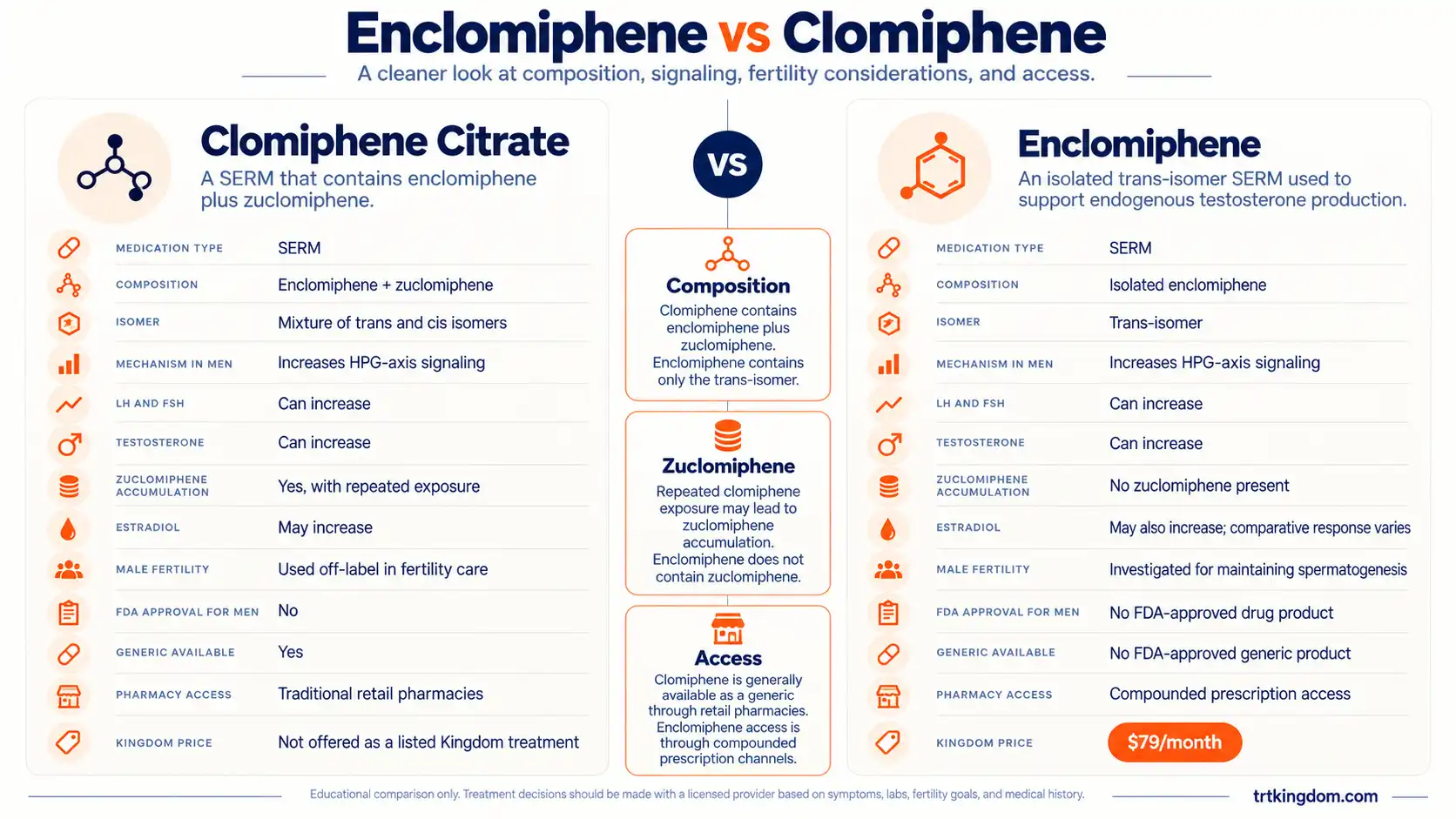
- Clomiphene citrate contains two geometric isomers: enclomiphene and zuclomiphene.
- Enclomiphene is the isolated trans-isomer and does not contain the longer-lasting zuclomiphene component.
- Both medications can raise testosterone in men, but limited comparative research suggests enclomiphene may produce fewer documented adverse effects.
- Enclomiphene has a half-life of about 10 hours. Zuclomiphene remains in the body much longer and can accumulate during clomiphene treatment.
- Generic clomiphene is generally easier to find at traditional pharmacies. Kingdom currently offers enclomiphene for $79 per month.
- Clomiphene is FDA-approved for ovulatory dysfunction in women, not male hypogonadism. Enclomiphene is not an FDA-approved drug product.
When comparing enclomiphene vs clomiphene, you are not really comparing two unrelated medications. Enclomiphene is one of the two isomers that make up clomiphene citrate. The other is zuclomiphene, a longer-lasting isomer with different pharmacologic behavior.
That sounds like a chemistry footnote. It isn't.
The difference between enclomiphene and clomiphene can affect how long the drug's components remain in the body, how testosterone and estradiol respond, and potentially how well a patient tolerates treatment.
And that is why two medications that work through essentially the same hormonal pathway do not always feel the same to the person taking them.
What Are Enclomiphene and Clomiphene?
Start with clomiphene citrate, better known by the brand name Clomid.
Clomiphene is a selective estrogen receptor modulator, or SERM. The FDA originally approved it for ovulatory dysfunction in women who want to become pregnant. Clinicians also prescribe clomiphene off-label in men for conditions including secondary hypogonadism and certain fertility problems.
But clomiphene is not one single molecular form.
It is a mixture of two geometric stereoisomers:
- Enclomiphene, the trans-isomer.
- And zuclomiphene, the cis-isomer.
Trans and cis describe how parts of the molecule are arranged around its double bond. In simple terms, the trans form and cis form contain the same atoms but arrange them differently in space, which can change how they behave in the body.
The FDA labeling for Clomid describes clomiphene citrate as containing between 30% and 50% of the cis-isomer, meaning the remainder is primarily the trans-isomer. Think of isomers a little like your left and right hands. They contain the same basic pieces. Put them next to each other and they clearly belong together. But you cannot place a left-hand glove on your right hand and expect exactly the same fit. Molecular orientation can change how a compound behaves in the body too.
Enclomiphene is the trans clomiphene isomer associated with the antiestrogenic activity used to stimulate the male hypothalamic-pituitary-gonadal axis, or HPG axis.
Here's the short version of that process.
Estradiol normally provides feedback to the hypothalamus and pituitary gland. SERMs interfere with estrogen receptor signaling in these areas. That can increase gonadotropin-releasing hormone, or GnRH, followed by increases in luteinizing hormone (LH) and follicle-stimulating hormone (FSH).
- LH signals the testes to make testosterone.
- FSH plays an important role in spermatogenesis.
Both clomiphene and enclomiphene can use this basic pathway to increase endogenous testosterone in appropriately selected men.
The chemical difference is that clomiphene gives you both isomers at once. Enclomiphene gives you the trans-isomer without the zuclomiphene component.
For a deeper look at the medication and HPG-axis mechanism, read our complete enclomiphene guide.
Why Does Zuclomiphene Matter?
This is the part of the clomiphene vs enclomiphene discussion worth understanding.
Enclomiphene does not stay in circulation forever. FDA's review of the available pharmacokinetic data describes an approximate half-life of 10 hours, with peak serum concentrations occurring around two to three hours after administration.
Zuclomiphene behaves differently. It persists much longer. FDA labeling for clomiphene notes that the cis-isomer may remain detectable for more than a month after treatment, and pharmacokinetic studies have demonstrated progressive accumulation of zuclomiphene during repeated clomiphene cycles. There is evidence for the same phenomenon in men.
A 2017 study measured both isomers in 15 men who had been taking clomiphene for at least six weeks. Median serum concentrations produced a zuclomiphene-to-enclomiphene ratio of 20:1 despite both components being present in the original medication.
Why? The shorter-lived enclomiphene clears relatively quickly. Zuclomiphene hangs around.
That does not automatically mean zuclomiphene is "bad." It has different estrogen receptor activity, including more estrogen-agonist behavior than enclomiphene, and researchers have long questioned how its accumulation influences clomiphene's clinical effects.
It also does not prove that every side effect someone experiences on Clomid was caused by zuclomiphene.
That claim goes too far.
What the evidence does suggest is that removing the longer-lasting cis-isomer changes the drug's pharmacology, and newer comparative data suggest that may matter clinically.
This is particularly relevant when discussing enclomiphene vs clomiphene side effects.
The 2024 AUA Study: What Happened When Men Switched?
This is probably the most interesting direct comparison we have.
A 2024 Journal of Urology abstract presented through the American Urological Association looked at 66 men who had originally taken clomiphene and later switched to enclomiphene.
That design matters. Researchers were not comparing two completely unrelated groups of men. They could look at what happened when the same clinical population moved from one SERM approach to the other.
The results? Enclomiphene produced a median testosterone increase of 166 ng/dL, and the authors concluded that the magnitude of testosterone improvement was comparable between the treatments.
The estradiol difference was more striking. The reported change was +17.50 pg/mL with clomiphene versus -5.92 pg/mL with enclomiphene, with a p-value of 0.001.
Documented adverse effects were also less frequent while patients were receiving enclomiphene. The study reported significant differences for decreased libido, reduced energy, and mood changes, and regression analysis found lower odds of overall adverse events with enclomiphene.
That is meaningful. It is not the same as proving enclomiphene is categorically safer or better for every man. This was a retrospective analysis of 66 patients, published as a conference abstract rather than a large randomized head-to-head trial. There is also much more long-term clinical experience with clomiphene than with isolated enclomiphene. Still, it gives us something better than theory. It shows that the isomer difference may actually translate into noticeable clinical differences.
Which One Raises Testosterone More?
Here's where the data become less satisfying. Both do.
A 2023 retrospective study compared 46 men receiving enclomiphene with 32 receiving clomiphene for at least three months. Total testosterone increased significantly within both treatment groups.
Median testosterone in the enclomiphene group increased from 390 to 581 ng/dL. In the clomiphene group, it increased from 244 to 470 ng/dL.
It would be tempting to look at those numbers and declare enclomiphene the winner. Don't. The groups started at very different baseline testosterone levels, the study was retrospective, and it was not designed to prove that one medication raises testosterone by a specific amount more than the other.
In fact, the 2024 AUA switch study concluded that testosterone improvement was comparable. So, is enclomiphene more effective than clomiphene? The current evidence does not support a simple yes. Both can raise testosterone. Where enclomiphene may separate itself is in gonadotropin response, sperm measures, pharmacokinetics, and tolerability.
The 2023 study found statistically significant increases in LH and FSH in the enclomiphene group, while those changes did not reach statistical significance in the clomiphene group. That makes the full hormone response more interesting than testosterone alone.
Which Works Faster?
There is no strong head-to-head study proving that one works faster.
Enclomiphene studies have demonstrated significant testosterone increases within about two weeks. Clomiphene can also change testosterone over a period of weeks, but studies use different doses, populations, and follow-up schedules.
So there is no evidence-based "enclomiphene works in X days, Clomid takes Y days" rule.
Which Is More Consistent?
Enclomiphene has a pharmacokinetic advantage on paper because there is no accumulating zuclomiphene component.
That may make its effects easier to interpret and adjust.
But "more consistent" should still be treated as a pharmacologic rationale rather than a guarantee that every man's testosterone numbers will be steadier.
Enclomiphene vs Clomiphene at a Glance
What About Side Effects?
The cleanest answer is this:
Enclomiphene may have a tolerability advantage, but neither drug is side-effect-free.
The FDA clomiphene label includes headache, nausea, vasomotor flushing, breast discomfort, and visual symptoms among reported adverse reactions, although those original clinical-trial data largely come from women treated for ovulatory dysfunction rather than men with hypogonadism.
Male experience with off-label clomiphene has also included reports of mood changes, libido changes, visual symptoms, gynecomastia, and changes in estradiol.
Enclomiphene can cause adverse effects too.
FDA's review of enclomiphene development data noted headache, hot flushes, nausea, and muscle spasms among the more commonly reported events. Blurred vision, headache, muscle spasm, and aggression were among events that led some participants to discontinue treatment.
So no, removing zuclomiphene does not remove every risk.
But the direct AUA comparison is hard to ignore. The 66-patient analysis found fewer documented adverse effects after patients switched to enclomiphene, including lower rates of decreased libido, reduced energy, and mood changes.
What About Visual Disturbances?
They can occur with SERMs.
Visual symptoms are specifically described in clomiphene labeling, and blurred vision has also appeared in enclomiphene safety data.
Any new visual symptoms while taking either medication deserve prompt medical attention.
Does Clomiphene Raise Estrogen?
It can. Clomiphene increases testosterone production, and some testosterone is converted to estradiol through aromatization. Estradiol can therefore rise during treatment.
Does Enclomiphene Raise Estrogen?
Also yes, potentially. This is where you need to be careful with the 2024 comparison.
That study found a more favorable change in estradiol on enclomiphene than clomiphene. [4]
But the 2023 study found that estradiol significantly increased from baseline within its enclomiphene group.
So "enclomiphene lowers estrogen" is not an accurate universal claim. Your estradiol response needs to be measured, not guessed.
Which Is Better for Fertility?
Both clomiphene and enclomiphene are very different from exogenous testosterone when fertility matters.
Because SERMs can increase LH and FSH rather than suppress them, both have been used or studied in men with hypogonadism and male infertility.
The 2023 study is particularly useful here.
Neither group showed a statistically significant worsening in semen concentration. Sperm motility improved significantly with both treatments. But total motile sperm count, or TMSC, improved significantly only in the enclomiphene group.
Does that prove enclomiphene is better for fertility? Not yet.
The study was relatively small and retrospective, and fertility is not measured by one semen parameter alone.
Clomiphene has a much longer history of off-label use by reproductive urologists and fertility specialists. Enclomiphene is newer and has less long-term clinical data.
Both may be considered in some men who need treatment for hypogonadism while preserving spermatogenesis.
Neither guarantees pregnancy. And neither should be used as a self-prescribed fertility treatment.
How Much Does Each Cost?
This comparison has changed more than the original brief suggests.
Generic clomiphene is available through traditional pharmacies, but current cash prices vary considerably by pharmacy, quantity, insurance, and discount program.
A September 2026 retail price guide lists generic 50 mg clomiphene at about $45 for 10 tablets or $115 for 30 tablets before insurance. Your actual monthly cost depends on the prescription because dosing in men is off-label and is not standardized by an FDA-approved male indication.
Clomiphene may also be covered by some insurance plans, but coverage for off-label male use varies.
Enclomiphene works differently from a retail-access standpoint.
There is no FDA-approved enclomiphene drug product or FDA-approved generic enclomiphene. Access in the U.S. may involve a compounded prescription when permitted under applicable pharmacy-compounding requirements.
Kingdom currently lists its physician-supervised enclomiphene program at $79 per month.
Why can enclomiphene cost more than generic clomiphene in some settings?
Mainly because you are not picking up an FDA-approved mass-market generic. Compounded medication involves a different supply and pharmacy process.
Insurance coverage for compounded enclomiphene is generally less predictable, and many telehealth programs operate on a cash-pay basis.
Kingdom accepts HSA and FSA payments for eligible expenses. Whether an outside clomiphene prescription qualifies depends on your plan and account administrator.
Are Either FDA-Approved for Men?
No.
Clomiphene citrate is FDA-approved for ovulatory dysfunction in women. Prescribing it for male hypogonadism or male infertility is off-label, meaning a clinician is using an FDA-approved medication for a condition, population, dose, or other circumstance not included in its approved labeling.
Enclomiphene is different. There is currently no FDA-approved enclomiphene drug product, so technically it is more precise to say that enclomiphene itself is not FDA-approved, rather than simply calling it "off-label."
Compounded drugs are also not FDA-approved and are not reviewed by FDA for safety, effectiveness, or quality before marketing.
FDA has evaluated enclomiphene citrate in connection with Section 503A compounding policy. The regulatory rules surrounding bulk substances and compounding are separate from ordinary FDA drug approval. In the U.S., clinicians may prescribe FDA-approved clomiphene off-label when medically appropriate. Enclomiphene may be prepared and dispensed as a compounded prescription when applicable federal and state compounding requirements and FDA enforcement-policy conditions are met. FDA currently lists enclomiphene citrate as a Category 1 bulk drug substance under evaluation under its Section 503A interim policy.
In practical terms: both require a prescription and clinician involvement when used in medical care, but they reach patients through different regulatory pathways.
Why Do Doctors Still Prescribe Clomiphene?
Because "newer" does not automatically mean "right for everyone." Clomiphene has been used in reproductive medicine for decades. Physicians know it. Traditional pharmacies carry generic versions. There is far more accumulated clinical experience with clomiphene than with isolated enclomiphene.
And some men do perfectly well on it.
That last point tends to get lost in comparisons like enclomiphene vs Clomid.
If a patient has a good testosterone response, acceptable semen parameters, no meaningful side effects, and affordable access to clomiphene, there may be no compelling reason to switch simply because another SERM exists.
Cost matters too. For someone whose insurance covers generic clomiphene but not compounded enclomiphene, the difference may be substantial.
Access can matter even more in areas where compounding options are limited.
So yes, clomiphene is still worth prescribing in selected patients.
The medication did not suddenly stop working when enclomiphene became available.
Who May Prefer Enclomiphene?
This is where the comparison becomes personal.
A clinician may consider enclomiphene for a man who:
- Has secondary hypogonadism and is an appropriate candidate for SERM therapy
- Wants to preserve endogenous testosterone production
- Wants fertility and spermatogenesis kept in the treatment conversation
- Previously experienced troublesome mood, libido, energy, or other adverse effects while using clomiphene
- Wants to avoid the longer-lasting zuclomiphene component
- Had an unfavorable estradiol response on clomiphene
- Is comfortable with compounded medication and cash-pay treatment
- Prefers a treatment whose pharmacology does not include accumulation of the cis-isomer
That does not mean enclomiphene is automatically "better."
It means the differences may matter more to certain patients.
If that profile sounds familiar, you can learn more about Kingdom's enclomiphene program with licensed provider supervision.
And if the bigger question is whether an oral SERM or testosterone replacement makes more sense, see our guide comparing enclomiphene with testosterone injections.
Who Might Still Prefer Clomiphene?
Clomiphene can still make sense for a patient who responds well and tolerates it.
The strongest reasons are pretty practical.
Generic clomiphene is widely available through conventional pharmacies. Some insurance plans may cover it. Providers, particularly reproductive urologists, have decades of experience prescribing it off-label.
And if somebody is doing well? There is no trophy for changing medications.
A patient who has stable labs, acceptable side effects, preserved fertility goals, and a treatment plan that works should not switch based on an internet comparison alone.
For someone focused heavily on cost, clomiphene may also remain the more accessible option depending on pharmacy pricing and insurance.
Switching From Clomiphene to Enclomiphene
Can you switch?
Yes, a clinician may transition a patient from clomiphene to enclomiphene.
The 2024 AUA study is essentially a real-world example of exactly that. All 66 men in the analysis had received clomiphene before switching to enclomiphene.
Why switch?
Side effects are one reason.
Estradiol response may be another.
Some patients and clinicians may also prefer removing the accumulating zuclomiphene component while keeping the SERM mechanism that stimulates LH and FSH.
What happens after the switch depends on the patient.
Zuclomiphene does not disappear immediately when the last clomiphene tablet is taken. Because it persists much longer than enclomiphene, its effects may overlap with the early transition period.
That does not mean every patient needs the same two-week or four-week washout.
There is no universally established switch protocol supported by high-quality comparative trials.
The provider may consider previous dose, treatment duration, symptoms, testosterone, LH, FSH, estradiol, fertility goals, and other factors when deciding when and how to transition.
Do You Need to Taper Clomiphene?
There is no established universal taper required for switching from clomiphene to enclomiphene.
But that is not an invitation to design your own transition.
Changes in prescription hormone therapy should still be coordinated with the prescribing clinician so labs and symptoms can be interpreted correctly.
Can You Take Clomiphene and Enclomiphene Together?
That generally makes little pharmacologic sense.
Clomiphene already contains enclomiphene. Adding isolated enclomiphene on top means combining two closely related SERM exposures while still keeping the zuclomiphene from clomiphene.
There is no established routine clinical benefit to taking both simultaneously.
If clomiphene is not working well, the clearer question is usually whether the treatment should be adjusted or changed.
If you are considering a switch, Kingdom's physician-led online hormone therapy program can evaluate your labs, symptoms, history, and fertility goals before a treatment decision is made.
Enclomiphene vs Clomiphene: Which One Makes More Sense?
After all the chemistry, this really comes down to one thing. Do the differences matter for you?
Clomiphene has something enclomiphene cannot match yet: decades of prescribing history, generic availability, conventional pharmacy access, and a much larger real-world track record.
Enclomiphene removes the long-lasting zuclomiphene isomer while retaining the trans-isomer associated with increased LH, FSH, and testosterone production. Early direct comparisons suggest that distinction may translate into fewer documented adverse effects and potentially different gonadotropin and semen responses.
Promising? Yes.
Settled science? Not quite.
So the enclomiphene vs clomiphene for men decision should not start with which medication sounds newer or cleaner.
It should start with your labs, why testosterone is low, how important fertility is, how you responded to previous treatment, what side effects you experienced, and what your provider thinks those pieces mean together.
If you want to find out whether enclomiphene may fit your situation, you can start your consultation with a licensed Kingdom provider.
Frequently Asked Questions
What is the difference between enclomiphene and clomiphene?
Clomiphene citrate contains both enclomiphene, the trans-isomer, and zuclomiphene, the cis-isomer. Enclomiphene treatment uses the isolated trans-isomer without the longer-lasting zuclomiphene component.
Is enclomiphene the same as Clomid?
No. Clomid is a brand name for clomiphene citrate, which contains both enclomiphene and zuclomiphene. Enclomiphene is only one of those two isomers.
Is enclomiphene better than clomiphene?
Not for every patient. A 2024 retrospective comparison found similar testosterone improvement with fewer documented adverse effects after men switched to enclomiphene, but larger long-term comparative trials are still needed.
Which raises testosterone more?
Current research does not establish a universal winner. Both clomiphene and enclomiphene can significantly raise testosterone, and individual response depends on baseline hormone levels, testicular function, dose, adherence, and other factors.
How long do enclomiphene and clomiphene take to work?
Enclomiphene has produced measurable testosterone increases within approximately two weeks in clinical research. Clomiphene can also affect testosterone within weeks, but there is no strong head-to-head evidence proving that one consistently works faster.
What is zuclomiphene?
Zuclomiphene is the cis-isomer contained in clomiphene citrate. It has different estrogen receptor activity and remains in the body much longer than enclomiphene, which can lead to accumulation during repeated clomiphene treatment.
Which has fewer side effects?
Limited direct evidence favors enclomiphene. In the 2024 AUA analysis, men had fewer documented adverse events on enclomiphene than during their earlier clomiphene treatment. Enclomiphene can still cause adverse effects, and its long-term safety database is smaller.
Which is safer for long-term use?
There is not enough evidence to say enclomiphene is universally safer long term. Clomiphene has substantially more years of real-world use, while enclomiphene has shown a potentially favorable tolerability profile in limited comparative research. Long-term treatment with either requires provider monitoring.
Which is better for fertility and sperm count?
Both SERMs can support the hormonal signaling involved in spermatogenesis. In a 2023 study, sperm motility improved in both groups, while total motile sperm count improved significantly only in the enclomiphene group. That finding is promising but does not prove enclomiphene produces better fertility outcomes or higher pregnancy rates.
Can clomiphene or enclomiphene treat male infertility?
Clinicians use clomiphene off-label in selected men with male infertility, and enclomiphene has also been studied in men with hypogonadism and fertility concerns. Whether either makes sense depends on the cause of infertility, hormone profile, semen analysis, and specialist evaluation.
Is clomiphene generic?
Yes. Multiple FDA-approved generic clomiphene citrate tablets are available. "Clomid" remains the familiar brand name, although patients may receive a generic clomiphene product instead.
Is enclomiphene generic?
There is no FDA-approved generic enclomiphene drug product because enclomiphene itself does not have an FDA-approved drug product in the United States. Available prescription enclomiphene may be compounded under applicable pharmacy-compounding requirements.
Does insurance cover clomiphene?
Sometimes. Coverage varies by insurer, diagnosis, pharmacy, and plan, and male treatment is off-label. Patients should check their own pharmacy benefit rather than assuming coverage.
Does insurance cover enclomiphene?
Coverage is generally less predictable because enclomiphene is not an FDA-approved commercially manufactured drug product and may be provided as a compounded medication. Many telehealth programs use cash-pay pricing.
Is enclomiphene worth the extra cost?
That depends on the patient. Someone experiencing adverse effects on clomiphene may value a treatment without zuclomiphene, while someone doing well on inexpensive generic clomiphene may have little reason to switch.
Are either FDA-approved for male hypogonadism?
No. Clomiphene is FDA-approved for ovulatory dysfunction in women and is prescribed off-label in men. Enclomiphene does not currently have an FDA-approved drug product.
This article is for educational purposes only and does not provide medical advice, diagnosis, or treatment. Prescription treatment requires evaluation by a licensed healthcare provider. Compounded medications are not FDA-approved and have not been evaluated by FDA for safety, effectiveness, or quality. Treatment availability and eligibility vary. Individual results may vary.