IF YOU NEED SUPPORT RIGHT NOW
If you are struggling with thoughts of self-harm or suicide, please reach out for support. In the US, call or text 988 for the 988 Suicide and Crisis Lifeline. This is a free, confidential service available 24 hours a day, 7 days a week. Outside the US, please contact your local emergency services or a national crisis line. This blog post is educational and is not a substitute for professional mental health care.
Key Takeaways
- Low testosterone and depression can share symptoms such as fatigue, low motivation, brain fog, sleep changes, and reduced libido.
- Symptoms alone cannot confirm testosterone deficiency.
- Sexual and physical changes, including reduced libido, erectile changes, loss of muscle mass, and reduced strength, may make a hormone evaluation more relevant.
- Diagnosing low testosterone generally requires compatible symptoms together with consistently low testosterone levels on appropriate blood testing.
- Low testosterone can occur alongside depression, but testosterone therapy is not a treatment for depression.
- If your symptoms suggest a possible hormone issue, a licensed provider can review your symptoms, medical history, and lab results to determine what may be contributing.
Low testosterone vs. depression: why can the symptoms feel so similar?
Feeling tired, unmotivated, foggy, or simply unlike yourself does not automatically point to one condition.
Low testosterone can affect energy, sexual function, body composition, concentration, sleep, and mood. Many of those symptoms can also occur with depression, chronic stress, poor sleep, certain medications, thyroid conditions, and other health issues.
That overlap is why symptoms alone are not enough to determine whether testosterone is low.
The more useful question is whether your symptoms include patterns that make a hormone evaluation worth considering.
What symptoms do low testosterone and depression share?
The symptom overlap can be significant.
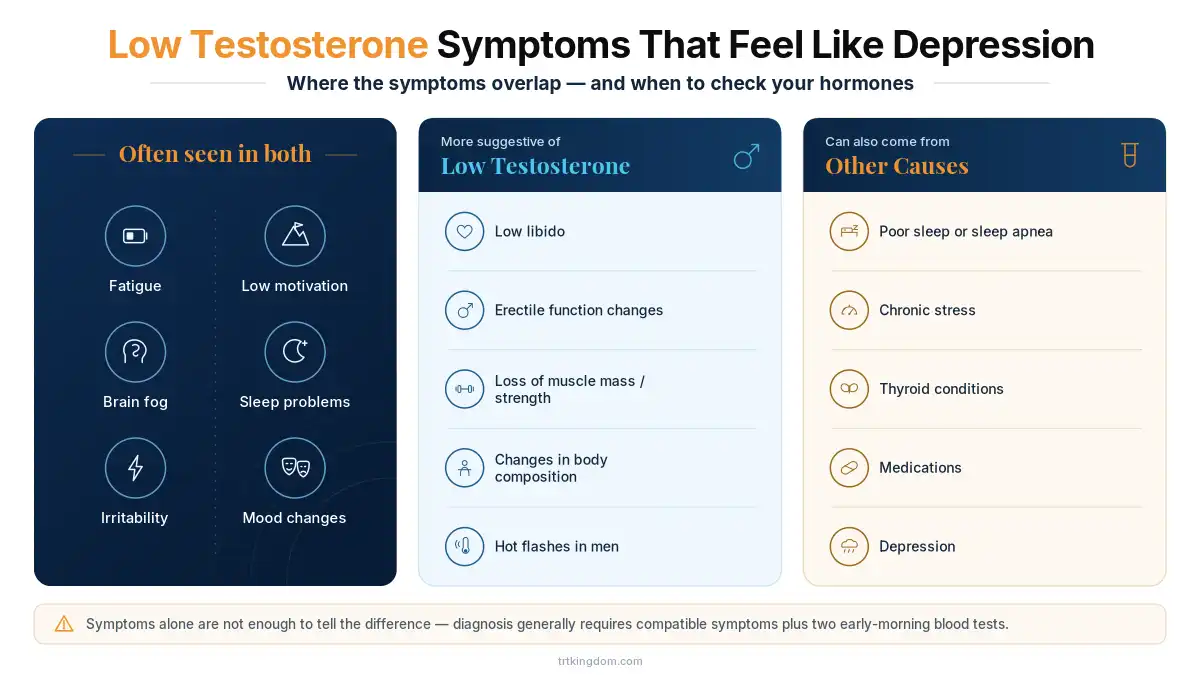
Fatigue, poor concentration, reduced motivation, sleep changes, and irritability are especially difficult to interpret because they are not specific to testosterone deficiency.
That is why providers typically look beyond general symptoms and consider whether more hormone-specific changes are occurring at the same time.
What symptoms point more toward low testosterone?
Certain physical and sexual symptoms may make testosterone testing more relevant, particularly when several occur together.
Reduced libido
A noticeable and persistent decline in sexual desire is one of the more common symptoms associated with testosterone deficiency.
Libido can change for many reasons, including stress, medications, relationship factors, sleep problems, and mental health conditions. But when reduced desire occurs alongside other symptoms of low testosterone, hormone testing may be appropriate.
Erectile function changes
Difficulty getting or maintaining erections can have many causes.
However, erectile changes occurring alongside reduced libido, fewer spontaneous erections, fatigue, or other possible signs of testosterone deficiency may warrant further evaluation.
Loss of muscle mass or strength
Testosterone plays an important role in maintaining muscle mass and strength.
A noticeable decline in either may be associated with testosterone deficiency, although training habits, nutrition, aging, medications, illness, and other health conditions can contribute as well.
Reduced energy
Low testosterone can be associated with lower energy.
Fatigue by itself is not enough to identify the cause because it can also result from inadequate sleep, stress, thyroid conditions, sleep apnea, medications, nutritional deficiencies, and numerous other factors.
The overall symptom pattern matters more than one isolated complaint.
Changes in body composition
Some men with testosterone deficiency may notice increased body fat or decreased lean mass.
Again, these changes are not specific to low testosterone and should be interpreted alongside symptoms, medical history, lifestyle factors, and laboratory testing.
Hot flashes
Hot flashes can occur in men when testosterone levels are very low.
They are less common than symptoms such as reduced libido or fatigue but can be another reason for a provider to consider hormonal causes.
When should you consider checking your testosterone?
A hormone evaluation may be worth discussing when general symptoms such as low energy or reduced motivation occur alongside more characteristic physical or sexual changes.
For example, someone experiencing fatigue alone may have dozens of possible explanations.
Someone experiencing fatigue together with reduced libido, fewer spontaneous erections, declining strength, and changes in body composition has a stronger reason to investigate whether testosterone may be contributing.
That does not mean low testosterone is necessarily the cause.
It means there is enough of a pattern to justify objective testing rather than guessing based on symptoms.
Can low testosterone affect mood and motivation?
Testosterone interacts with biological systems involved in energy, motivation, sexual function, mood, and stress response.
Men with testosterone deficiency may report symptoms such as:
- Reduced motivation
- Irritability
- Low energy
- Difficulty concentrating
- Sleep changes
- Reduced sense of well-being
- Low mood
Research has also found an association between low testosterone and depression in some populations.
A 2004 study by Shores and colleagues followed 278 men age 45 and older. During the two-year follow-up, 21.7% of men with consistently low testosterone were diagnosed with depression compared with 7.1% of men whose testosterone levels were normal.
That finding shows an association. It does not establish that low testosterone directly causes depression.
The practical takeaway is simpler: mood-related symptoms can occur with testosterone deficiency, but they should not be used to diagnose low testosterone by themselves.
Can depression or chronic stress affect testosterone?
Possibly.
Long-term stress, poor sleep, reduced physical activity, weight changes, illness, and other factors can influence hormone health.
Chronic stress can also affect the hypothalamic-pituitary-adrenal axis, which helps regulate the body's stress response. Some of the behavioral and physiological changes associated with prolonged stress may indirectly affect testosterone levels.
That does not mean stress automatically causes testosterone deficiency.
Similarly, having depression does not automatically mean testosterone will be low.
Testosterone deficiency still requires an appropriate clinical evaluation and blood testing.
How is low testosterone diagnosed?
Low testosterone is not diagnosed based on fatigue, low motivation, libido changes, or mood symptoms alone.
Providers typically look for both compatible symptoms and consistently low testosterone levels.
Morning testosterone testing
Testosterone levels are generally highest earlier in the day, which is why testing is commonly performed in the morning.
Repeat testing
A single low result is generally not enough to establish testosterone deficiency.
Low testosterone is typically confirmed with a second early-morning measurement on a separate day.
Additional hormone testing
Depending on your initial results, symptoms, health history, and fertility goals, a provider may also consider additional testing such as:
- Free testosterone
- SHBG
- LH
- FSH
- Prolactin
- Estradiol
These tests can provide additional context and help a provider understand why testosterone may be low.
Total vs. free testosterone
Total testosterone is generally the starting point for evaluation.
The American Urological Association uses a total testosterone level below 300 ng/dL as a reasonable cutoff supporting a diagnosis when compatible symptoms are also present.
Free testosterone may provide additional information in certain situations, but lab values should always be interpreted alongside symptoms and clinical history.
There is no single testosterone number that explains every symptom.
What happens if testing confirms low testosterone?
Treatment depends on your symptoms, laboratory results, medical history, fertility goals, and provider evaluation.
Testosterone replacement therapy
For men with symptoms of testosterone deficiency and consistently low testosterone levels, testosterone replacement therapy may be considered when a licensed provider determines treatment is appropriate.
Treatment should be individualized and monitored over time.
Learn more about testosterone cypionate and how treatment may be structured under provider supervision.
Lifestyle and underlying factors
Sleep, resistance training, weight management, medication use, alcohol consumption, certain medical conditions, and other health factors may influence testosterone levels.
Depending on the cause of low testosterone, addressing these factors may be part of the overall treatment plan.
Fertility considerations
Testosterone therapy can suppress sperm production.
Men who currently want children or may want children in the future should discuss fertility goals with their provider before starting treatment.
For some men, enclomiphene or another approach may be considered instead of testosterone replacement depending on symptoms, laboratory results, fertility goals, and provider evaluation.
Does TRT improve mood if testosterone is low?
Some men with testosterone deficiency report improvements in overall well-being, energy, motivation, or mood after appropriate treatment.
Research into testosterone therapy and depressive symptoms has produced mixed results.
Some studies have found improvements in depressive symptoms among selected men, while other research has shown less consistent effects.
TRT should therefore not be viewed as a treatment for depression.
The purpose of testosterone therapy is to treat appropriately diagnosed testosterone deficiency.
If significant or persistent mental health symptoms are present, they should be evaluated separately by an appropriate healthcare professional.
What if mood changes occur after starting TRT?
Hormone therapy requires ongoing monitoring.
If you notice significant mood changes, new symptoms, or worsening emotional symptoms after starting treatment, contact your provider.
Your provider can review your symptoms, laboratory results, medications, dosing, and treatment plan to determine whether adjustments or additional evaluation may be appropriate.
Do not change or stop prescribed treatment without speaking with your provider.
What about testosterone and mood in women?
The relationship between testosterone and mood in women is still being studied, and the evidence is less clear than it is in men.
Testosterone plays a role in female physiology, including sexual function, but symptoms such as fatigue, low mood, or reduced motivation are not enough to determine whether testosterone is low.
Hormone levels also change throughout a woman’s life.
During perimenopause and menopause, symptoms can be influenced by changes in estrogen and other hormones as well as sleep disruption, stress, medications, physical health, and mental health.
Current clinical guidance does not recommend testosterone therapy as a treatment for depression or general low mood in women.
The strongest evidence for testosterone therapy in women is for carefully selected women with hypoactive sexual desire disorder (HSDD) following a thorough clinical evaluation.
For women with sexual health or hormone-related concerns, our women’s testosterone therapy program offers access to licensed providers who can evaluate symptoms, medical history, and relevant lab results to determine whether treatment may be appropriate.
Not sure whether your symptoms could be low testosterone?
Fatigue, poor concentration, reduced motivation, and sleep changes can have many possible causes.
But when those symptoms occur alongside changes such as reduced libido, erectile function changes, decreased muscle mass or strength, or other signs associated with testosterone deficiency, checking your hormone levels may provide useful information.
A licensed provider can review the complete picture rather than relying on symptoms alone.
If you want to explore whether testosterone may be contributing to how you feel, talk to a licensed provider about appropriate testing and next steps.
Frequently Asked Questions
Can low testosterone cause depression or anxiety?
Low testosterone has been associated with depressive symptoms in some men, including low mood, fatigue, irritability, and reduced motivation. However, depression and anxiety are separate conditions with many possible causes. Mood symptoms alone cannot determine whether testosterone is low.
How do I know whether my symptoms could be related to low testosterone?
General symptoms such as fatigue, brain fog, low motivation, poor sleep, and irritability can have many causes. Reduced libido, erectile changes, fewer spontaneous erections, decreased muscle mass, reduced strength, or changes in body composition occurring alongside those symptoms may provide a stronger reason to consider hormone testing.
How is low testosterone tested?
Evaluation generally begins with total testosterone measured in the morning. A low result is typically confirmed with a second early-morning test on a separate day. Depending on the results and your medical history, a provider may order additional hormone testing.
Does total or free testosterone matter?
Total testosterone is generally used as the initial measurement. Free testosterone can provide additional information in selected cases, particularly when total testosterone results do not clearly match symptoms or when SHBG levels may affect interpretation.
Neither measurement should be interpreted in isolation.
Can you have symptoms of low testosterone even if fatigue is your main complaint?
Yes, but fatigue alone is highly nonspecific.
A provider will usually consider whether other symptoms associated with testosterone deficiency are present and whether another condition could better explain the fatigue.
Can TRT affect mood?
Hormonal changes can affect how some patients feel, which is one reason treatment should include ongoing provider oversight and laboratory monitoring.
Report significant or unexpected mood changes to your provider rather than adjusting treatment on your own.
Can chronic stress lower testosterone?
Chronic stress may indirectly influence testosterone through effects on sleep, physical activity, weight, metabolic health, and stress-response pathways.
Stress alone does not establish testosterone deficiency. Diagnosis still requires compatible symptoms and appropriate blood testing.
Can low testosterone affect women too?
Women produce testosterone as well, but symptoms and appropriate treatment differ from those in men.
Low mood or fatigue alone should not be attributed to testosterone. Testosterone therapy has specific evidence-based uses in appropriately evaluated women and should be considered only under qualified provider supervision.