TRT KINGDOM
HCG for Men: The Complete Guide to Uses, Dosage & Benefits
Talk to a Licensed Provider Today
Key Takeaways
- HCG (human chorionic gonadotropin) is a prescription hormone that mimics luteinizing hormone (LH) to stimulate testicular testosterone output and support fertility.
- Most commonly prescribed alongside TRT to help prevent testicular atrophy and maintain sperm production.
- Typical TRT adjunct protocols use 500 to 1,000 IU injected subcutaneously 2 to 3 times per week.
- FDA-approved for specific male conditions (such as hypogonadotropic hypogonadism), and prescribed off-label as a TRT adjunct under physician supervision.
- Common side effects include mild injection-site irritation, water retention, occasional mood shifts, and elevated estradiol, making follow-up labs essential.
- Not a DEA-controlled substance and not a steroid, though it requires diagnostic labs and a valid prescription from a licensed physician.
Starting or already on TRT, Thinking ahead about fertility. Not willing to let testicular function shut down.
Testosterone replacement therapy solves a real problem when blood work confirms a deficiency, but external testosterone comes with a predictable trade-off. Once exogenous hormone enters circulation, your brain dials back the signals that tell your testes to stay active, which can shrink testicular volume and sharply reduce sperm counts.
Human chorionic gonadotropin (HCG) keeps that local signal switched on. By mimicking luteinizing hormone (LH) directly at the testes, HCG helps preserve testicular function and fertility alongside TRT, and in selected cases of secondary hypogonadism it's used on its own. Typically given as a quick subcutaneous injection 2 to 3 times per week, here's what you should know before adding it to a protocol.
What Is HCG?
Human chorionic gonadotropin, universally called HCG, is a glycoprotein hormone produced naturally by the placenta during pregnancy. In men's medicine, it's used therapeutically for a straightforward biological reason: its molecular structure closely mirrors luteinizing hormone (LH), the pituitary signal that tells the testes to manufacture testosterone and support sperm maturation.
That LH-like action makes HCG uniquely useful during hormone therapy. When exogenous testosterone is introduced through TRT, negative feedback suppresses your brain's own LH release, leaving the testes unstimulated. HCG works around that bottleneck by directly activating LH receptors in the testes, keeping testicular tissue functional even while exogenous testosterone is on board.
HCG is FDA-approved for specific clinical indications, including prepubertal cryptorchidism (undescended testes not caused by anatomical obstruction), selected cases of hypogonadotropic hypogonadism in men, and certain female fertility protocols. Using HCG alongside TRT to preserve testicular fullness and fertility is off-label, though backed by clinical research and widely established in modern hormone care.
Two things to know upfront: unlike testosterone cypionate, HCG is not a DEA-scheduled controlled substance, and it isn't a steroid. You still need lab work and a real prescription from a licensed physician. Depending on formulation availability, patient dosing needs, and federal biologic pharmacy rules, HCG is dispensed either as FDA-approved commercial vials or through appropriately licensed pharmacy channels.
What Is HCG Used For in Men?
HCG serves several distinct clinical purposes in men, most often as a targeted adjunct alongside testosterone replacement. Where it fits depends on your lab profile and treatment priorities:
- Preserving testicular function on TRT: Exogenous testosterone suppresses endogenous LH and FSH. Without those signals, the testes stop producing hormone locally and can shrink over time (testicular atrophy). HCG mimics LH to maintain normal testicular size and activity throughout TRT.
- Preserving fertility during TRT: Standard TRT frequently lowers or halts sperm production. Adding HCG maintains intratesticular testosterone, helping support ongoing spermatogenesis in men who want to keep future family planning on the table during long-term therapy.
- Treating secondary hypogonadism: When the testes work properly but the brain fails to send adequate LH signals, HCG can be prescribed as monotherapy to stimulate natural testosterone output without starting external testosterone, an approach sometimes favored by younger men.
- Post-cycle or post-TRT recovery: Under close physician supervision, HCG can be incorporated into a customized recovery protocol to help wake up dormant testicular tissue in men coming off TRT or prior anabolic steroid use.
But here's the catch: HCG only works if your Leydig cells are physically capable of answering an LH signal. It won't overcome primary testicular failure, and it isn't a shortcut around baseline diagnostic blood work.
Important Notice: TRT Kingdom does not prescribe HCG for weight loss, bodybuilding, or athletic performance enhancement. HCG weight loss diets are not supported by legitimate medical evidence and carry explicit FDA warnings. Prescriptions are issued only after a thorough medical evaluation confirms clinical appropriateness.
Learn more about Kingdom's testosterone replacement therapy program and how HCG fits into broader treatment protocols.
How Does HCG Work?
Normally, your pituitary gland releases pulses of luteinizing hormone (LH) that travel through the bloodstream and bind to Leydig cells in the testes, prompting them to produce testosterone. When you inject HCG, it binds to those exact same LH receptors, instructing the testes to keep producing testosterone locally and maintain normal tissue volume.
That downstream entry point is why HCG pairs with TRT in a way oral SERMs usually can't. Exogenous testosterone triggers strong negative feedback at the hypothalamus and pituitary, shutting down natural LH output. Without LH, intratesticular testosterone drops sharply even when blood testosterone looks optimal. HCG bypasses the suppressed pituitary completely and stimulates Leydig cells directly.
Keeping intratesticular testosterone intact also indirectly supports Sertoli cells and the local environment required for sperm creation. While HCG alone doesn't directly replace follicle-stimulating hormone (FSH), maintaining that testicular environment is why clinical studies show concomitant HCG helps preserve spermatogenesis during TRT.
In the body, HCG has an approximate half-life of 24 to 36 hours. That's why protocols split dosing across 2 to 3 injections per week instead of one large weekly shot, keeping testicular stimulation steadier and avoiding unnecessary hormone spikes
Interested in Adding HCG to Your TRT Protocol?
HCG Dosage Overview
There's no single standard HCG dose. The right weekly amount looks very different for a man maintaining testicular fullness alongside TRT than it does for someone running HCG monotherapy for secondary hypogonadism.
Common HCG Dosing Protocols in Men
These are common clinical protocol examples, not instructions for self-dosing. All HCG dosing must be determined and adjusted by a licensed physician.
How Is the Right Dose Determined?
Dividing your weekly total across 2 to 3 smaller injections delivers steadier testicular stimulation than larger, infrequent shots. Your provider adjusts dosing based on follow-up blood work, particularly total testosterone and sensitive estradiol, alongside symptom feedback and fertility goals.
Never raise your own HCG dose or inject more often than prescribed. Pushing HCG higher than needed drives excess conversion to estradiol, increases fluid retention and mood swings, and can reduce Leydig cell responsiveness over time.
How to Inject HCG
HCG is typically given as a shallow subcutaneous (SubQ) injection into fatty tissue, which is simpler and far less uncomfortable than deep intramuscular shots. Your provider or pharmacy team will walk through exact preparation steps before your first dose.
Reconstituting HCG and Refrigeration
Most HCG arrives as a lyophilized (freeze-dried) powder vial paired with a separate vial of bacteriostatic water. You mix the water into the powder gently following the exact volume on your pharmacy instructions to reach your prescribed concentration. Once reconstituted, HCG must be refrigerated and typically stays stable for 30 to 60 days depending on concentration. Never freeze mixed HCG, and discard any vial past its beyond-use or expiration date.
Common Subcutaneous Injection Sites
- Lower abdomen (staying at least two inches clear of the belly button)
- Upper outer thigh
- Flank or "love handle" area
Needle Sizes
Most protocols use a fine insulin syringe (29 to 31 gauge, 1/2-inch length). Because the needle is ultra-thin and enters just beneath the skin, self-administration is quick and nearly painless.
Injection Technique Basics
Swab the vial top and skin with alcohol, let dry, pinch a small fold of skin, insert the needle at a 45- to 90-degree angle, inject slowly, withdraw cleanly, and apply light pressure with sterile gauze if needed. Rotate injection sites each time to avoid local skin irritation. If any step feels unclear, check with your provider before injecting rather than guessing.
HCG Results Timeline on TRT
How quickly does HCG work? Local testicular changes often show up within a couple of weeks, while sperm production and solo testosterone shifts follow a longer biological clock.
Results Timeline at a Glance
A cleaner look at what changes, and when. Estimates based on clinical HCG and TRT research. Individual results vary.
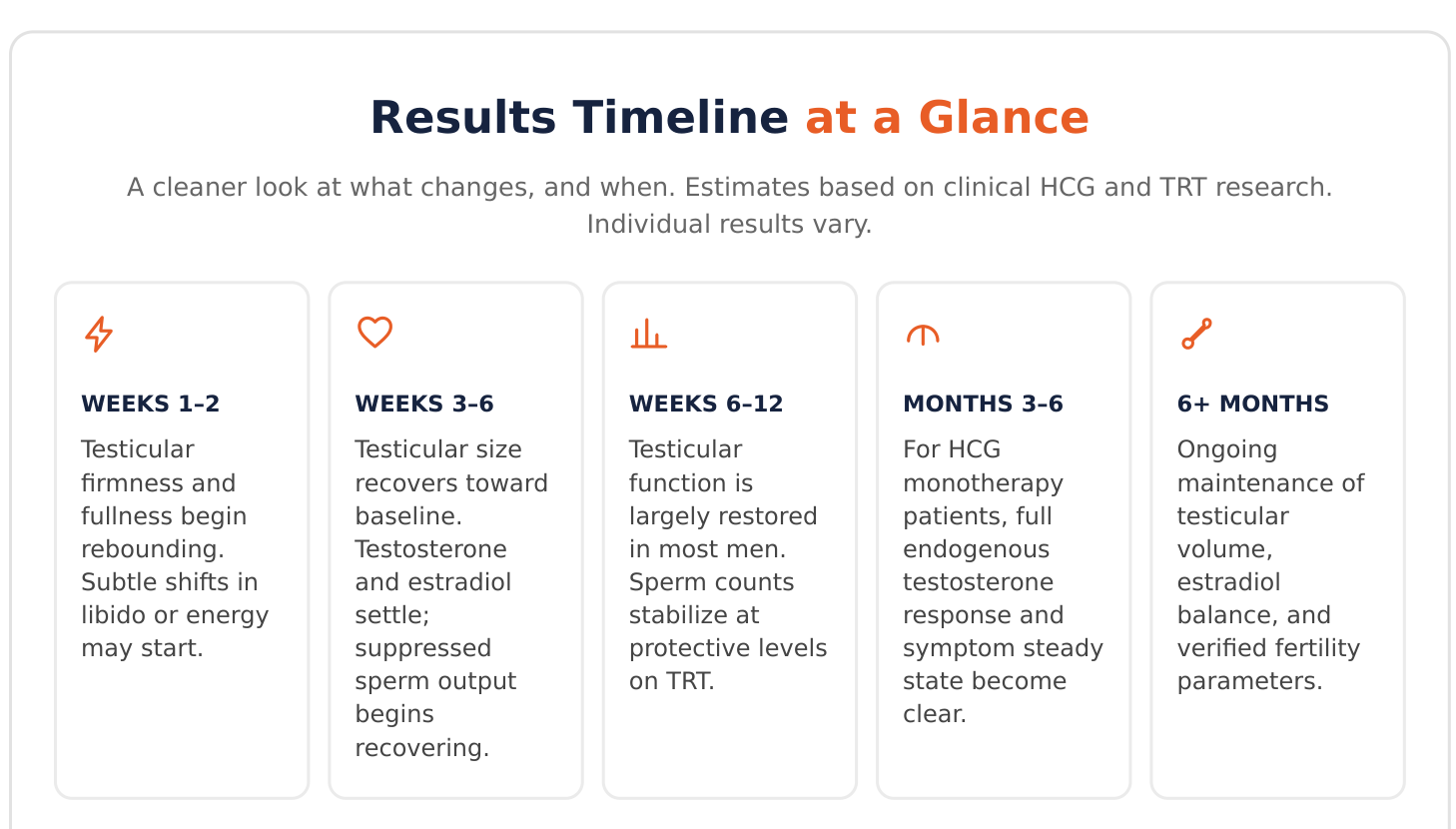
Individual results vary based on baseline testicular function, dose, how long you used TRT before adding HCG, and overall health status.
HCG Side Effects
HCG is generally well-tolerated, particularly at modest TRT adjunct doses. Even so, boosting intratesticular hormone production can push estrogen upward before you feel obvious symptoms, which is why routine blood work isn't optional.
Common Side Effects
- Injection-site reactions (mild redness, swelling, or brief soreness)
- Mild water retention
- Slight breast tissue sensitivity
- Mood changes in some patients
- Mild acne
- Uncommon mild headaches
Less Common Side Effects
- Gynecomastia: breast tissue growth if estradiol climbs significantly and stays unaddressed
- Elevated estradiol: increased estrogen conversion alongside testicular stimulation
- Fatigue: occasional tiredness in some patients
- Mild mood swings: emotional fluctuations during dose changes
- Allergic reactions: rare hypersensitivity reactions
Serious Side Effects: Seek Medical Care For
- Severe allergic reaction (difficulty breathing, swelling of the face or throat, or severe rash)
- Signs of a blood clot (leg swelling with pain, chest pain, or sudden shortness of breath)
- Significant mood changes or worsening depression
- Severe pelvic pain or unexpected abdominal swelling
Managing Estradiol on HCG
Increased estradiol conversion is the #1 lab trend clinicians watch on HCG. Because HCG raises intratesticular testosterone, more substrate is available for aromatase conversion into estradiol. Routine sensitive-estradiol labs catch elevations early so your provider can adjust your HCG or TRT dose, or consider an aromatase inhibitor only if clinically warranted.
Men not yet on exogenous TRT who want a non-injectable route can also ask their provider about enclomiphene as a fertility-preserving option, which works upstream at the hypothalamus rather than directly at the testes.
Warnings and Contraindications
HCG isn't appropriate for every patient. Certain medical histories make treatment unsafe or call for closer clinical screening.
Do Not Use If You Have:
- Hormone-sensitive cancers, including known or suspected prostate cancer or male breast cancer
- Known allergy to HCG or any ingredient in the formulation
- Precocious puberty (in prepubertal or adolescent males)
- Active deep vein thrombosis (DVT) or a history of blood clots
Use With Caution If You Have:
These conditions require careful medical evaluation before starting HCG (particularly given fluid-retention sensitivity):
- Cardiovascular disease or fluid-sensitive heart conditions
- Kidney or liver disease
- Epilepsy or seizure disorder
- Migraine headaches
- Asthma
Note: Commercial HCG prescribing labels also carry female-specific warnings (such as ovarian cyst or hyperstimulation risks) that apply to female fertility patients rather than men.
Drug Interactions
HCG has relatively few direct drug interactions, though care is needed alongside medications affecting hormone balance or blood clotting. Tell your provider about every medication and supplement you use, including testosterone or anabolic steroids, SERMs (clomiphene, enclomiphene, tamoxifen), and aromatase inhibitors.
HCG vs. Other Fertility-Preserving Options
Men who want to protect testicular function and fertility have four main clinical options, each acting at a different point in the hormone pathway:
- HCG: Directly stimulates testicular Leydig cells, preserves testicular size, and supports spermatogenesis. Effective both alongside TRT and as monotherapy.
- Enclomiphene: Daily oral SERM that blocks hypothalamic estrogen feedback to raise natural LH and FSH. Best suited for men not yet on exogenous TRT or early in hormone optimization.
- Clomiphene (Clomid): Older mixed-isomer oral SERM with a similar mechanism to enclomiphene and lower generic cost, though it carries a heavier side effect burden.
- FSH (Follicle-Stimulating Hormone): Directly stimulates Sertoli cells to drive sperm production; sometimes layered onto HCG when men have active conception goals requiring maximum spermatogenesis support.
For men already on testosterone cypionate or preparing to start TRT, HCG is typically the first-choice adjunct because it acts directly on the testes even while pituitary LH is suppressed. See how injectable replacement works in our testosterone cypionate guide or explore Kingdom's testosterone cypionate program.
Monitoring Requirements on HCG
Structured lab work verifies that HCG is maintaining hormone balance without pushing estradiol or red blood cell markers out of range.
Baseline Labs (Before Starting HCG)
Before prescribing HCG, a licensed provider will typically check total testosterone, free testosterone, estradiol (sensitive assay preferred), LH and FSH, and SHBG, along with a complete blood count (CBC) and comprehensive metabolic panel (CMP). When fertility preservation is a priority, a baseline semen analysis is also recommended.
Follow-Up Monitoring Schedule
- 6 to 8 weeks after starting: Recheck testosterone, sensitive estradiol, and relevant markers to gauge response and fine-tune your dose.
- 3 months after starting: Full hormone and safety panel to confirm your protocol is dialed in.
- Every 6 months long-term: Comprehensive lab panel to track ongoing safety, estradiol control, and overall hormone balance.
Fertility-Specific Monitoring
Blood tests alone don't confirm sperm counts. Men using HCG to protect fertility should complete periodic semen analyses, typically every 3 to 6 months during the first year and annually once parameters are stable.
Start Your HCG Consultation Today
HCG Cost and Insurance
What you'll pay for HCG depends on the formulation source, your weekly IU dose, and whether it's bundled into a broader TRT plan.
Compounded HCG (where dispensed through appropriately licensed pharmacy channels) typically runs $75 to $200 per month depending on dose. Brand-name commercial HCG vials (Novarel, Pregnyl, and historically Profasi) generally range from $150 to $400 per month depending on dose and pharmacy pricing (for reference, Kingdom offers a 10,000 IU commercial vial for $299, which spans roughly two months at standard adjunct dosing). Inconsistent manufacturer supply in recent years has directly shaped pharmacy availability across the U.S.
Telehealth TRT programs that include HCG often bundle consultations and monitoring, with HCG typically adding $50 to $100 per month onto base program pricing. Insurance occasionally covers HCG for narrow FDA-approved diagnoses, though off-label TRT adjunct use is rarely reimbursed. Most patients pay out of pocket or use eligible HSA/FSA funds.
How to Get HCG Prescribed Online
Obtaining HCG through telehealth follows a structured medical workflow designed around diagnostic labs and real physician oversight:
- Health intake questionnaire. Share your symptoms, medical history, current medications, and priorities (fertility preservation, testicular fullness, or hormone optimization).
- Blood work. Complete diagnostic labs covering testosterone, estradiol, LH, FSH, and safety markers, plus a semen analysis if fertility is a primary goal.
- Telehealth consultation. Meet by video with a licensed physician who reviews your labs, symptoms, and goals to confirm whether HCG fits your clinical picture.
- Prescription decision. When clinically appropriate, a prescription is issued, either alongside TRT or as a standalone protocol. If HCG isn't the right match, your provider will walk through alternatives.
- Medication delivery. Approved prescriptions are fulfilled through a licensed U.S. pharmacy partner and shipped directly to your door with clear reconstitution and storage instructions.
- Ongoing monitoring. Regular follow-up check-ins and repeat labs keep your dose effective and estradiol well-controlled.
Prescriptions are issued strictly after a legitimate medical evaluation confirms clinical need, never for weight loss, bodybuilding, or athletic enhancement. Ready to explore your options? View Kingdom's medically-supervised HCG program or book a free provider consultation.
Brand Names and Formulations
In the United States, HCG has been marketed under several commercial brand names, including Novarel (Ferring Pharmaceuticals), Pregnyl (Organon), and historically Profasi (now largely unavailable), alongside compounded HCG formulations dispensed where permitted under applicable federal biologic and state pharmacy regulations.
Periodic supply shortages among major commercial manufacturers have led many telehealth clinics to rely on specialized pharmacy fulfillment so patients don't face mid-protocol gaps. Note that unlike FDA-approved commercial biologics such as Pregnyl and Novarel, compounded preparations are not FDA-approved or evaluated by the FDA for safety, effectiveness, or quality before marketing, though licensed formulations use the same active hormone when dosed appropriately.
Frequently Asked Questions
Is HCG a steroid?
No. HCG is a glycoprotein hormone that mimics luteinizing hormone (LH). It is not an anabolic steroid and is not classified as a controlled substance by the DEA.
Does HCG raise testosterone levels?
Yes. HCG stimulates Leydig cells in the testes to produce endogenous testosterone. In men with responsive testes, HCG monotherapy can raise testosterone meaningfully, often back into the physiological range in secondary hypogonadism.
Can HCG be used without testosterone?
Yes. HCG monotherapy is a legitimate option for men with secondary hypogonadism who want to stimulate their own testosterone production rather than replace it externally, keeping natural testicular function and fertility active.
Does HCG preserve fertility on TRT?
Yes, in clinical studies adding HCG to TRT helps maintain intratesticular testosterone and spermatogenesis compared with testosterone alone. Men needing maximum fertility support sometimes add FSH alongside HCG under specialist care.
How quickly does HCG work?
Improvements in testicular size and firmness often show up within 1 to 2 weeks. Testosterone gains on HCG monotherapy build over 4 to 8 weeks, while measurable sperm recovery typically takes 3 to 6 months of consistent use.
Can HCG be used for weight loss?
No. HCG weight loss diets are not supported by credible medical evidence, are rejected by major medical societies, and have been the subject of explicit FDA consumer warnings.
Does HCG cause side effects?
At standard TRT adjunct doses (500 to 1,000 IU 2 to 3 times weekly), HCG is generally well-tolerated. Mild injection-site redness, slight water retention, or mood shifts can occur, and elevated estradiol is tracked through routine labs.
How much does HCG cost per month?
Compounded HCG typically runs $75 to $200 per month depending on dose, while brand-name vials often cost $150 to $400 per month (Kingdom offers a 10,000 IU commercial vial for $299). Bundled telehealth TRT add-ons commonly add $50 to $100 per month.
Does insurance cover HCG?
Insurance coverage is limited and rarely reimburses off-label TRT adjunct use. Most patients pay out of pocket or use eligible HSA/FSA funds.
Can I buy HCG online?
HCG cannot legally be purchased over the counter. You can obtain a prescription online through a licensed telehealth clinic after a medical evaluation and diagnostic blood work, fulfilled by a licensed U.S. pharmacy.
How do I store HCG after mixing?
Once reconstituted with bacteriostatic water, HCG must be refrigerated and typically remains stable for 30 to 60 days depending on concentration. Never freeze mixed HCG, and always follow your pharmacy's beyond-use date.
Is HCG the same as HGH?
No. HCG (human chorionic gonadotropin) and HGH (human growth hormone) are completely different hormones. HCG mimics LH to support testicular testosterone and fertility, whereas HGH acts on growth, metabolism, and tissue repair.
Get Started With Provider-Supervised HCG Therapy



Dr. Daniel Olivero