TRT KINGDOM
Nandrolone Decanoate: The Complete Guide to Uses, Dosage & Benefits
Talk to a Licensed Provider Today
Key Takeaways
- Nandrolone decanoate is a long-acting injectable medication structurally related to testosterone, used selectively to support recovery capacity, joint comfort, and lean tissue maintenance.
- Classified as a Schedule III controlled substance, prescribed strictly by licensed physicians for legitimate medical indications.
- Conservative adjunct protocols typically run 100 to 200 mg every 1 to 2 weeks (or 50 to 100 mg weekly) under close provider supervision alongside TRT.
- Its decanoate ester yields an approximate 6- to 12-day half-life, allowing weekly or bi-weekly intramuscular dosing.
- Research has examined its interaction with collagen synthesis and connective tissue pathways, making it a targeted option when joint durability lags behind hormone optimization.
- Requires more extensive lab monitoring than TRT alone, including lipids, hematocrit, prolactin, testosterone, and estradiol.
Sometimes optimizing testosterone isn't the whole story. Even when blood levels sit comfortably in range, some men still deal with slow recovery after physical stress, persistent joint discomfort, or trouble holding onto lean tissue.
Nandrolone decanoate enters that conversation as a targeted hormone adjunct, never a standalone substitute for testosterone or a shortcut for cosmetic muscle gain. Because it's a Schedule III controlled substance with real effects on cholesterol, prolactin, and natural hormone signaling, it calls for careful screening and serious lab oversight. Here's what you should know before discussing it with a physician.
What Is Nandrolone Decanoate?
Nandrolone decanoate is a synthetic androgen structurally related to testosterone, paired with a decanoate ester chain that extends how long it stays active after injection. It belongs to the anabolic-androgenic steroid (AAS) class and has decades of prescription history in clinical medicine, including catabolic muscle-wasting states, certain anemias, and postmenopausal osteoporosis.
Delivered as an oil-based intramuscular injection, the decanoate ester slows release from muscle tissue into the bloodstream, creating an approximate half-life of 6 to 12 days. That slow depot release makes weekly or every-two-week dosing practical instead of frequent injections.
Under federal law, nandrolone decanoate is a Schedule III controlled substance. You cannot legally obtain it without diagnostic blood work, a real medical evaluation, and a valid prescription from an appropriately licensed physician. While mainstream commercial prescribing shifted over recent decades as newer targeted therapies emerged for anemia and bone loss, conservative protocols remain part of specialized hormone care.
In modern clinical practice, nandrolone is positioned exclusively as an adjunct therapy rather than primary hormone replacement. Providers evaluate it only when recovery capacity, connective tissue support, and physical durability remain unresolved concerns alongside optimized testosterone.
What Is Nandrolone Decanoate Used For?
Nandrolone decanoate has several established and off-label clinical roles. Whether it belongs in a treatment plan depends on what remains unresolved after foundational care:
- Supporting recovery and tissue repair: In modern hormone care, nandrolone is most often considered for men whose testosterone is already optimized yet who continue experiencing sluggish recovery, lingering soreness, or difficulty maintaining lean mass. Binding androgen receptors in muscle and connective tissue helps support protein turnover and tissue maintenance.
- Joint comfort considerations: Research has explored nandrolone's interaction with collagen-related pathways and connective tissue. When persistent joint discomfort hasn't responded to standard conservative measures, a physician may evaluate nandrolone within a broader, monitored plan.
- Lean muscle maintenance: Androgen-receptor signaling supports nitrogen retention and muscle preservation in men struggling to hold lean tissue despite dialed-in TRT.
- Specific medical indications: Historically, nandrolone decanoate has been prescribed for muscle wasting (including HIV-associated wasting), anemias of chronic disease, and postmenopausal osteoporosis, though alternative therapies now lead many of those legacy indications.
But here's the catch: nandrolone isn't a painkiller, and it won't repair torn ligaments, structural joint damage, or poor sleep and programming. Adjunct prescribing only makes clinical sense once baseline hormones, labs, and root causes have been thoroughly evaluated.
Important Notice: TRT Kingdom does not provide nandrolone decanoate for bodybuilding, athletic performance enhancement, or cosmetic muscle gain. Treatment is considered only after a thorough medical evaluation by a licensed provider confirms legitimate medical need, typically as a conservative adjunct focused on recovery and physical durability.
Patients interested in comprehensive hormone care can learn more about our testosterone replacement therapy program and how nandrolone fits into broader treatment protocols as an adjunct therapy.
How Does Nandrolone Decanoate Work?
Nandrolone works by binding to androgen receptors in skeletal muscle, bone, and connective tissue. Activating those receptors stimulates cellular pathways tied to protein synthesis, nitrogen retention, and structural tissue maintenance. Unattached nandrolone clears quickly on its own; adding the decanoate ester slows absorption from the injection site and stretches its half-life to roughly 6 to 12 days.
Where nandrolone diverges from testosterone is how your body metabolizes it. Unlike testosterone, which converts via 5-alpha-reductase into potent dihydrotestosterone (DHT), nandrolone converts into a much weaker androgen (dihydronandrolone) and aromatizes to estrogen at substantially lower rates. That distinct ratio explains both why physicians consider it when TRT alone leaves recovery or joint concerns behind, and why nandrolone cannot replace baseline testosterone on its own.
Studies have also investigated nandrolone's relationship with collagen synthesis and connective tissue, suggesting localized interactions that may support joint comfort in appropriately selected patients. Because clinical data for off-label joint and recovery use remain evolving, physician oversight and lab tracking are essential.
One reality doesn't change: nandrolone is an exogenous androgen that triggers negative feedback on the hypothalamic-pituitary-gonadal (HPG) axis. It suppresses natural testosterone production and sperm output rather than stimulating them, which has direct implications for fertility planning.
Interested in Nandrolone as a Recovery Adjunct?
Nandrolone Decanoate Dosage Overview
Nandrolone dosing isn't guesswork, and modern hormone care looks nothing like high-dose bodybuilding folklore. All dosing is set and adjusted by a licensed physician based on your baseline testosterone protocol, symptoms, and safety labs.
Common Conservative Nandrolone Adjunct Protocols
These are conservative clinical protocol examples, not instructions for self-dosing. Nandrolone decanoate is a Schedule III controlled substance and must be prescribed and adjusted by a licensed physician.
Why Conservative Dosing Matters and How Doses Are Adjusted
Legacy inpatient protocols for severe wasting or anemia often used higher doses than modern outpatient hormone clinics prescribe. Today's clinical standard favors conservative adjunct dosing because the goal is supporting recovery and tissue durability while keeping lipid, hematocrit, and prolactin shifts in check.
Providers typically recheck labs at 4 to 6 weeks, 3 months, and every 6 months long-term. Never self-adjust your nandrolone dose or injection frequency; pushing higher without supervision raises real risks of dyslipidemia, elevated blood viscosity, prolactin spikes, and cardiovascular strain.
How to Inject Nandrolone Decanoate
Because nandrolone decanoate is suspended in an oil carrier, it is administered by deep intramuscular (IM) injection so the depot absorbs smoothly over its half-life. Your provider or clinical team will walk through proper sterile technique before you self-inject at home.
Common Intramuscular Injection Sites
- Ventrogluteal (upper outer hip/buttock muscle, widely preferred in modern practice)
- Vastus lateralis (outer middle third of the thigh muscle)
- Dorsogluteal (upper outer quadrant of the buttock, used less commonly today)
Injection Site Rotation
Consistent rotation prevents scar tissue buildup and local soreness. On bi-weekly schedules, alternating left and right sides works cleanly; men injecting weekly or more often should rotate across at least four distinct muscle sites in a repeating cycle.
Needle Sizes
Most protocols pair a larger 18-gauge drawing needle (to pull the thick oil cleanly from the vial) with a fresh 22- to 25-gauge, 1- to 1.5-inch needle swapped on for the actual intramuscular injection.
Storage and Handling
Store nandrolone decanoate at controlled room temperature away from direct light and heat. Do not refrigerate or freeze oil-based vials. Inspect the solution before every draw; if the oil looks cloudy or contains particles, do not inject it and contact your pharmacy for a replacement.
Nandrolone Decanoate Results Timeline
How quickly does nandrolone work? Because the decanoate ester releases gradually, blood levels build over several weeks before tissue and recovery benefits fully settle in.
Results Timeline at a Glance
A cleaner look at what changes, and when. Estimates based on conservative clinical adjunct use. Individual results vary.
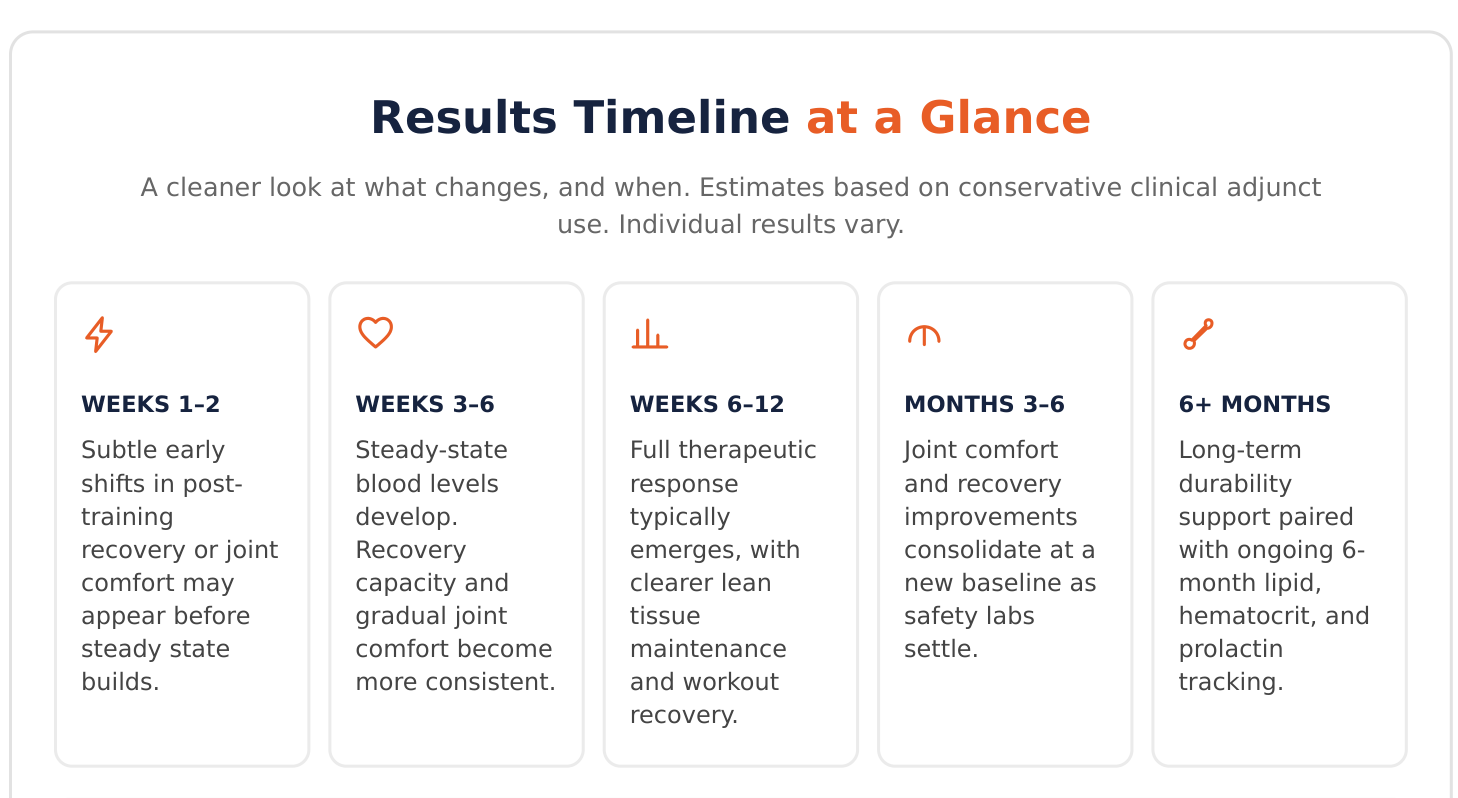
Individual results vary based on baseline health, prescribed dose, concurrent TRT balance, sleep, training load, and treatment goals.
Nandrolone Decanoate Side Effects
Nandrolone carries a distinct side effect profile that differs from testosterone alone, especially around cholesterol, hematocrit, and prolactin. Several of its most important risks have zero early symptoms and only show up on blood work.
Common Side Effects
- Injection-site reactions (localized soreness, redness, or mild swelling)
- Mild to moderate water retention
- Elevated hematocrit (increased red blood cell concentration)
- Lipid profile shifts (lowered HDL cholesterol and elevated LDL in some men)
- Suppression of natural testosterone production
- Reduced sperm count and suppressed fertility
Less Common Side Effects
- Elevated prolactin: hormone shift that can blunt sexual function if left unchecked
- Decreased libido: reduced sex drive in some patients, especially if testosterone ratios drift
- Erectile function changes: often linked to elevated prolactin or inadequate baseline androgen support
- Mood or sleep changes: irritability, emotional shifts, or disrupted sleep
- Hair loss acceleration: possible in men genetically predisposed to male-pattern thinning
Serious Side Effects: Seek Immediate Medical Care For
- Signs of cardiac strain (chest pain, shortness of breath, or marked leg/ankle swelling)
- Signs of a blood clot (painful leg swelling or sudden difficulty breathing)
- Severe mood changes or worsening depression
- Yellowing of the skin or eyes (potential liver dysfunction)
- Severe allergic reaction involving breathing difficulty or facial/throat swelling
Managing Prolactin on Nandrolone
Unlike standard testosterone, nandrolone exhibits progestogenic activity that can push prolactin levels upward, directly affecting libido and erectile quality. Routine prolactin testing is standard for every man on nandrolone, allowing your physician to adjust your nandrolone-to-testosterone ratio or prescribe targeted prolactin management when clinically needed.
Fertility Considerations
Nandrolone suppresses endogenous LH, FSH, and sperm production just as exogenous TRT does. Men who want to protect testicular function and fertility alongside therapy typically discuss HCG as a fertility-preserving option with their physician. For men not currently on TRT who want to support natural hormone output without exogenous androgens, enclomiphene as an alternative may be a better conversation to start with.
Warnings and Contraindications
Nandrolone decanoate carries strict medical contraindications and requires thorough cardiovascular, prostate, and metabolic screening before starting.
Do Not Use If You Have:
- Prostate cancer or any history of suspected or confirmed prostate carcinoma
- Male breast cancer
- Severe cardiovascular disease or uncontrolled heart failure
- Severe liver dysfunction or active hepatic disease
- Severe kidney disease (including nephrosis)
- Known allergy to nandrolone decanoate or its carrier oil/excipients
Nandrolone is also strictly contraindicated in women who are or may become pregnant.
Use With Caution If You Have:
- Cardiovascular disease or significant cardiac risk factors
- Elevated baseline hematocrit
- Elevated baseline prolactin
- Lipid disorders or a history of dyslipidemia
- Benign prostatic hyperplasia (enlarged prostate / BPH)
- Obstructive sleep apnea
- Diabetes or impaired glucose tolerance
- History of mood disorders
Drug Interactions
Nandrolone can alter how several medication classes behave, including oral anticoagulants (heightened bleeding risk), insulin and oral diabetes medications (altered blood glucose needs), corticosteroids (increased fluid retention), and other hormone therapies. It can also influence certain laboratory test values. Share every prescription, OTC drug, and supplement with your physician upfront.
Nandrolone Decanoate vs. Testosterone
Although structurally related, nandrolone decanoate and testosterone serve completely different roles in clinical hormone care:
- Testosterone Cypionate: Primary hormone replacement designed to correct confirmed low testosterone, directly supporting energy, libido, mood, erections, bone density, and muscle. See our full guide on testosterone cypionate for complete details.
- Nandrolone Decanoate: Targeted hormone adjunct with distinct affinity for muscle and connective tissue, lower 5-alpha-reductase androgenic conversion, and lower estrogen aromatization. Not a standalone replacement for testosterone.
In practice, nandrolone is evaluated only after baseline testosterone has been optimized and specific recovery or joint durability issues remain. For most men, supervised testosterone cypionate therapy is the foundational treatment, with nandrolone layered in selectively when a physician confirms clear clinical benefit.
Monitoring Requirements on Nandrolone Decanoate
Because nandrolone affects cholesterol, blood viscosity, and prolactin more noticeably than TRT alone, lab surveillance is broader and non-negotiable.
Baseline Labs (Before Starting Nandrolone)
Before prescribing nandrolone, your physician will generally review total testosterone, free testosterone, estradiol (sensitive assay), prolactin, and LH and FSH, alongside a complete blood count (CBC) with hematocrit, comprehensive metabolic panel (CMP) including liver enzymes, a full lipid panel (total cholesterol, HDL, LDL, triglycerides), blood pressure assessment, PSA for men over 40, and a semen analysis when fertility is a priority.
Follow-Up Monitoring Schedule
- 4 to 6 weeks after starting: Recheck lipids, hematocrit, prolactin, testosterone, and estradiol to evaluate early response and catch emerging shifts promptly.
- 3 months after starting: Full baseline panel repeat to confirm the adjunct protocol remains safe and well-balanced.
- Every 6 months long-term: Comprehensive lab panel to monitor lipid trends, hematocrit, organ function, and whether continuing nandrolone remains clinically justified.
Why Lipid Monitoring Is Critical
Nandrolone can push HDL ("good") cholesterol down and LDL ("bad") cholesterol up even at modest doses. Checking a full lipid panel early and every 6 months lets your provider intervene, lower the dose, or discontinue the adjunct before unfavorable cardiovascular trends take hold.
Start Your Nandrolone Consultation Today
Nandrolone Decanoate Cost and Insurance
Monthly costs depend on pharmacy sourcing, conservative weekly dosing, and how your clinic structures adjunct hormone plans.
Compounded nandrolone decanoate from a licensed 503A pharmacy typically runs $75 to $125 per month at conservative adjunct doses, making it the primary channel for modern protocols (Kingdom's nandrolone plans start at $89/month on a 2.5-month plan). Commercial brand-name nandrolone has very limited availability in the U.S. retail market today, with variable pricing where stocked.
Telehealth hormone programs often bundle clinical visits and monitoring, with nandrolone commonly adding $50 to $100 per month onto base TRT program pricing. Insurance coverage for hormone optimization adjuncts is very limited, so most patients pay out of pocket or use eligible HSA and FSA funds when prescribed for a documented medical indication.
How to Get Nandrolone Decanoate Prescribed Online
Because nandrolone decanoate is a Schedule III controlled substance, legitimate telehealth clinics follow a strict diagnostic and prescribing process:
1. Health intake questionnaire. Complete a thorough medical history covering symptoms, current medications, cardiac/metabolic history, and specific recovery or joint durability concerns.
2. Comprehensive blood work. Complete diagnostic labs including testosterone, estradiol, LH, FSH, prolactin, CBC/hematocrit, full lipid panel, and liver markers.
3. Telehealth consultation. Meet via video with a licensed physician who reviews your labs, TRT history, and goals to determine whether an adjunct is clinically justified.
4. Prescription decision. If clinically appropriate, a conservative prescription is issued. If sleep, recovery habits, or standalone TRT adjustments should come first, your physician will outline that plan clearly.
5. Medication delivery. Valid prescriptions are fulfilled by a licensed 503A compounding pharmacy in compliance with federal and state controlled-substance laws and shipped discreetly to your home.
6. Ongoing monitoring. Scheduled follow-up visits and expanded safety labs keep lipids, hematocrit, and prolactin closely tracked over time.
Prescriptions are issued only after a legitimate medical evaluation confirms clinical appropriateness, never for bodybuilding, athletic enhancement, or cosmetic muscle gain. Ready to discuss your options? Explore Kingdom's medically-supervised nandrolone program or book a free provider consultation.
Brand Names and Formulations
Historically, nandrolone decanoate has been referenced in the United States under commercial brand names including Deca-Durabolin (now with very limited U.S. availability) and Hybolin Decanoate (an older legacy brand), alongside compounded nandrolone decanoate from licensed 503A pharmacies, which serves as the standard source for modern conservative adjunct protocols.
Unlike commercial FDA-approved drug products, compounded medications are not FDA-approved or evaluated by the FDA for safety, effectiveness, or quality before marketing. Because compounding standards can differ across pharmacies, working with a telehealth clinic that partners exclusively with vetted, state-licensed U.S. pharmacies is essential for consistent concentration and sterility.
Frequently Asked Questions
Is nandrolone decanoate a steroid?
Yes. Nandrolone decanoate is classified medically as an anabolic-androgenic steroid (AAS) and legally as a Schedule III controlled substance, requiring a valid prescription from a licensed physician for legitimate medical use.
What is the difference between nandrolone and testosterone?
Nandrolone has lower androgenic conversion and aromatizes to estrogen at lower rates than testosterone, with distinct interactions in connective tissue. Testosterone is primary hormone replacement; nandrolone is strictly a targeted adjunct.
Does nandrolone preserve fertility?
No. Like other exogenous androgens, nandrolone suppresses endogenous LH, FSH, and sperm production. Men prioritizing fertility require dedicated adjunct support such as HCG under physician guidance.
How long does nandrolone take to work?
Subtle shifts in recovery may appear within 1 to 2 weeks, steady-state blood levels build over 3 to 6 weeks, and fuller recovery and tissue-support benefits typically emerge across 6 to 12 weeks.
What are the typical nandrolone side effects?
Common side effects include injection-site soreness, mild water retention, elevated hematocrit, cholesterol shifts (lower HDL, higher LDL), and natural hormone suppression. Elevated prolactin is also a specific nandrolone watchpoint.
Can I take nandrolone with testosterone?
Yes. Pairing conservative nandrolone doses as an adjunct alongside TRT is its standard modern clinical use, requiring physician supervision and expanded blood work.
Is nandrolone safe long-term?
In appropriately screened patients using conservative doses, ongoing therapy can be managed under close medical supervision, provided lipids, hematocrit, blood pressure, and prolactin remain healthy on regular labs.
How much does nandrolone cost per month?
Compounded nandrolone typically costs $75 to $125 per month for conservative adjunct dosing (Kingdom plans start at $89/month on a 2.5-month plan), or adds roughly $50 to $100 per month when bundled into a TRT program.
Does insurance cover nandrolone?
Insurance coverage for adjunct hormone optimization is very limited. Most patients pay out of pocket or use eligible HSA/FSA funds when prescribed for a documented medical need.
Can I buy nandrolone online?
It cannot legally be bought without a prescription. Eligible patients can be evaluated online by a licensed telehealth physician and, when clinically appropriate, receive prescriptions through a licensed compounding pharmacy.
Who is a good candidate for nandrolone?
It's generally reserved for men whose testosterone is already optimized yet who face persistent recovery, joint comfort, or lean-tissue durability concerns, never for cosmetic muscle gain or athletic enhancement.
Does nandrolone cause erectile dysfunction?
It can affect erectile function in some men, usually when prolactin rises or nandrolone is run without an adequate testosterone base. Maintaining proper TRT balance and monitoring prolactin helps minimize this risk.
Get Started With Provider-Supervised Nandrolone Therapy



Dr. Daniel Olivero