TRT KINGDOM
Testosterone Cypionate: The Complete Guide to Uses, Dosage & Side Effects
Talk to a Licensed Provider Today
Key Takeaways
- Testosterone cypionate is an FDA-approved injectable used to treat certain forms of low testosterone in men.
- It replaces testosterone directly instead of nudging your body to make more of it.
- Its ~8-day half-life means injections don't have to happen daily. Levels stay steadier between doses.
- Side effects can include acne, fluid retention, elevated hematocrit, and reduced sperm production, which is why monitoring matters.
- It's a prescription medication and a Schedule III controlled substance. That means blood tests, medical supervision, and a real diagnosis, not a quiz and a credit card.
Low energy, Less interest in sex, Workouts that don't feel quite the same anymore.
It's easy to blame getting older. But sometimes low testosterone is part of the picture, and when blood tests confirm a deficiency, treatment may be worth considering.
Testosterone cypionate is one of the most established options out there. It's been used for decades, but there's still plenty of confusion about how it works, how it's dosed, and what you can realistically expect. Here's what you should know before getting started.
What Is Testosterone Cypionate?
Testosterone cypionate is a long-acting, injectable form of testosterone used to treat certain types of testosterone deficiency. The testosterone is attached to a cypionate ester, a chemical chain that slows absorption, so the hormone releases gradually after each injection instead of all at once.
The result? Testosterone stays in your system longer. Given intramuscularly, it has an approximate half-life of eight days, which is why dosing schedules are spaced out rather than daily.
Two things to know upfront: it's FDA-approved for certain forms of male hypogonadism, and it's a Schedule III controlled substance. You need a valid prescription, full stop.
What Is Testosterone Cypionate Used For?
It treats certain forms of hypogonadism, the condition where your body doesn't produce enough testosterone on its own. There are two main types:
- Primary hypogonadism: The problem starts in the testes, which can't produce enough testosterone.
- Secondary hypogonadism: The brain isn't sending the right hormonal signals to the testes.
Low testosterone can contribute to symptoms like:
- Reduced sex drive
- Persistent fatigue
- Loss of muscle mass
- Changes in mood
- Difficulty concentrating
- Reduced bone density
But here's the catch: these symptoms aren't unique to low testosterone. Poor sleep, thyroid problems, certain medications, and other health conditions can look identical. That's why a real diagnosis takes blood tests, symptom history, and medical background, not a symptom checklist.
Learn more about Kingdom's testosterone replacement therapy program and the treatment options available.
How Does Testosterone Cypionate Work?
Unlike medications that try to coax your body into producing more testosterone, cypionate supplies the hormone directly. After an injection, it's gradually absorbed into your bloodstream: levels rise, then slowly decline until your next dose. That's why injection timing matters. Larger doses spaced farther apart can create more noticeable peaks and valleys, while smaller, more frequent doses can help some patients keep steadier levels.
Once in your bloodstream, testosterone acts on receptors throughout the body, in muscle, bone, and reproductive tissues. Some of it also converts into estradiol and dihydrotestosterone (DHT), hormones with effects of their own.
There's a trade-off, though. External testosterone can suppress your body's natural production and reduce sperm production, something your provider should discuss with you before day one.
Considering Testosterone Cypionate?
Testosterone Cypionate Dosage Overview
There's no universal dose, and anyone selling you one-size-fits-all dosing isn't being straight with you. The right amount depends on your testosterone levels, medical history, treatment response, and side effect profile.
The FDA-approved prescribing information lists 50 to 400 mg every 2 to 4 weeks for certain forms of hypogonadism, and clinical guidelines also describe shorter dosing intervals.
Common Testosterone Cypionate Dosing Schedules
These are examples from labeling and clinical guidance, not instructions for self-dosing.
How Is the Right Dose Determined?
Blood tests show how your levels are responding. Symptoms and side effects complete the picture. More testosterone isn't necessarily better. Raising your dose without medical guidance raises the risk of complications, including elevated hematocrit. Dose adjustments are your provider's call, based on your labs and how you actually feel.
How to Inject Testosterone Cypionate
Testosterone cypionate is given by injection, and some patients are trained to self-inject at home. Before your first dose, your provider should walk you through the correct technique, supplies, and injection site for your specific prescription.
Intramuscular vs. Subcutaneous
You may hear about two methods:
• Intramuscular (IM): the medication goes into muscle, using a generally longer needle. This is the approved route on FDA labeling for testosterone cypionate, and it's the established method.
• Subcutaneous (SubQ): the medication goes into fatty tissue beneath the skin, using a generally shorter needle. This is off-label for standard testosterone cypionate, though some providers prescribe it when appropriate.
Both methods have been studied, but they aren't automatically interchangeable. Standard FDA-approved testosterone cypionate is labeled for intramuscular use.
Common Injection Sites
IM injections are commonly given into the gluteal muscle, though other muscle sites may be used under clinical guidance. When subcutaneous administration is prescribed, fatty tissue around the abdomen or thigh may be used. Your provider will show you exactly where and how to inject.
Injection Site Rotation
Repeatedly injecting the same spot can cause irritation and tissue changes. Rotating between approved sites gives each area time to recover. Never inject into bruised, inflamed, or damaged skin.
Needle Sizes
Needle length and thickness depend on the injection method, location, and your individual build. Use the supplies recommended by your provider or pharmacist, and always use sterile equipment.
Storage and Handling
Follow your medication label. Testosterone cypionate is generally stored at controlled room temperature, protected from light. If the solution looks unusual or contains unexpected particles, check with your pharmacist before using it.
Testosterone Cypionate Results Timeline
How quickly does it work? Your testosterone levels start changing after an injection, but feeling a difference takes longer. Research on testosterone replacement therapy suggests the general timeline below. These are research-based estimates, not guaranteed results.
Results Timeline at a Glance
A cleaner look at what changes, and when. Research-based estimates from testosterone replacement therapy studies. Not guaranteed results.
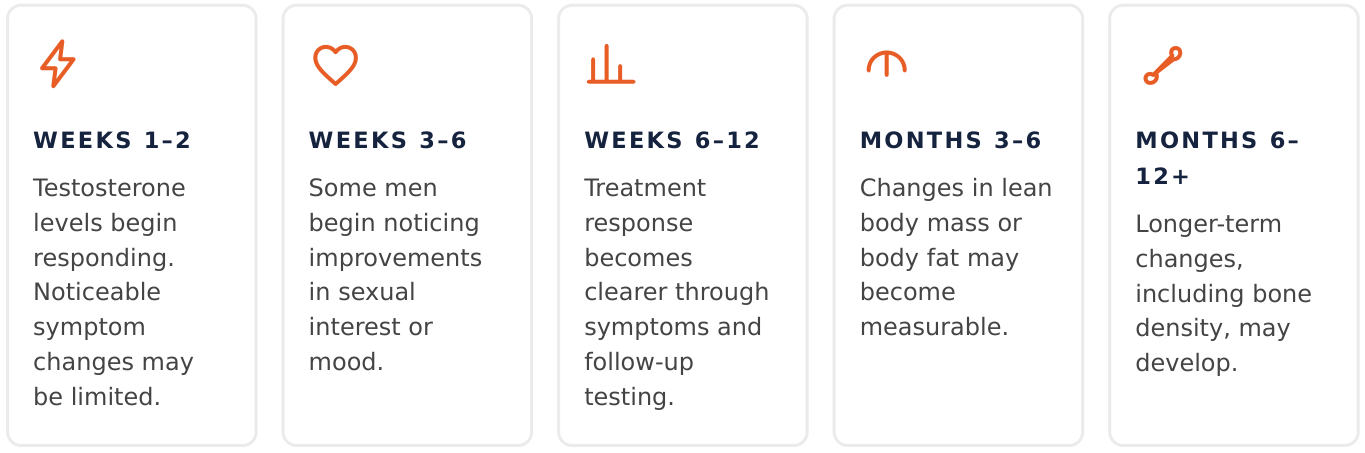
If fatigue or poor concentration persist despite improved levels, the cause may be something else. Worth investigating with your provider rather than automatically raising the dose.
Testosterone Cypionate Side Effects
Cypionate has real side effects, and some aren't immediately noticeable. You might recognize acne or fluid retention, but an elevated red blood cell count usually only shows up on blood work. This is why monitoring isn't optional.
Common Side Effects
• Acne and oily skin
• Injection-site soreness or irritation
• Fluid retention
• Changes in sex drive
• Increased red blood cell counts and hematocrit
Not everyone experiences these, and severity varies from person to person.
Less Common Side Effects
• Gynecomastia: enlargement of breast tissue
• Testicular atrophy: shrinking of the testes as natural production is suppressed
• Reduced fertility: lower sperm counts, sometimes a complete absence of sperm during treatment
• Hair loss: possible acceleration of male-pattern hair loss in genetically susceptible men
• Mood changes: irritability, anxiety, or other shifts
• Sleep apnea: possible worsening of an existing condition
Serious Side Effects: Seek Emergency Care For
• Chest pain or sudden difficulty breathing
• Facial drooping, sudden weakness, or difficulty speaking
• Painful leg swelling, especially with shortness of breath
• A painful erection lasting more than four hours
• Severe allergic reactions involving breathing difficulty or facial swelling
Testosterone can also raise blood pressure, so monitoring matters even when you feel fine.
Long-Term Considerations
The long-term cardiovascular effects of testosterone therapy have been studied extensively. In the 2023 TRAVERSE trial, researchers followed more than 5,200 men with hypogonadism and cardiovascular risk factors. Testosterone therapy did not increase the trial's primary measure of major cardiovascular events compared with placebo. That's reassuring, but not a free pass. The study used testosterone gel, not cypionate injections, and the testosterone group did experience higher rates of atrial fibrillation, pulmonary embolism, and acute kidney injury.
Fertility is the other big one. Testosterone therapy can suppress sperm production, which matters if you're planning to have children. A provider may discuss adding HCG to preserve testicular function, or enclomiphene as a fertility-preserving option. Neither guarantees preserved fertility, and enclomiphene is not FDA-approved.
Testosterone Cypionate Warnings and Contraindications
Cypionate isn't suitable for everyone, even with low testosterone.
Do Not Use If You Have:
Depending on the product's prescribing information, contraindications include:
• Known or suspected prostate cancer
• Male breast cancer
• Allergy to testosterone cypionate or its ingredients
• Certain serious heart, liver, or kidney conditions
It's also contraindicated during pregnancy.
Use With Caution If You Have:
These conditions need additional evaluation before treatment:
• Elevated hematocrit
• High blood pressure or cardiovascular disease
• Untreated severe sleep apnea
• History of blood clots
• Significant urinary symptoms
• Plans to have children
Recent cardiovascular events or uncontrolled heart failure may also make TRT inappropriate.
Drug Interactions
Testosterone cypionate can interact with several medications. Warfarin may see altered anticoagulant effects. Insulin and diabetes medications may affect blood sugar control. Corticosteroids may increase fluid retention. Tell your provider about every medication and supplement you take before starting.
Testosterone Cypionate vs. Other Testosterone Esters
Not all injectable testosterone works on the same schedule. The difference comes down to how quickly each ester is absorbed and how long it stays active.
• Cypionate: long-acting, with an ~8-day half-life.
• Enanthate: similar to cypionate, with comparable clinical use.
• Propionate: shorter-acting, generally requiring more frequent injections.
• Undecanoate: longer-acting, with extended dosing intervals.
Cypionate and enanthate are especially similar. There's little evidence that one consistently delivers better clinical results than the other. Testosterone gel is another option for men who'd rather avoid injections, though daily application and the risk of transferring medication to others are real considerations.
Monitoring Requirements on Testosterone Cypionate
TRT isn't set-it-and-forget-it. Blood tests show whether your levels are responding and whether treatment is causing unwanted changes.
Baseline Labs (Before Starting)
Before prescribing testosterone, your provider will generally check testosterone levels and review your medical history. Additional testing may include a complete blood count (including hematocrit), LH and FSH to help identify the cause of low testosterone, free testosterone when appropriate, PSA testing based on age and individual risk, and other relevant health markers.
Follow-Up Monitoring
Follow-up testing often begins within the first 3 to 6 months, though the schedule depends on the medication and your health. Your provider checks testosterone levels, hematocrit, symptoms, and side effects during the first months, then moves to periodic labs and reassessment on an ongoing basis. Some patients need more frequent monitoring, especially after dose changes or when safety concerns arise.
Target Ranges
The goal isn't to push testosterone as high as possible. Clinical guidelines generally recommend keeping levels within an appropriate physiological range while tracking symptoms and safety markers. If your blood levels improve but your symptoms don't, your provider may need to look beyond testosterone.
Ready to Explore Testosterone Therapy?
Testosterone Cypionate Cost and Insurance
Prices vary depending on where you get treatment and what's included. A pharmacy prescription may cost less upfront, but consultations, blood work, and follow-up visits can add to the total. Telehealth programs often bundle some of these services into their pricing.
Kingdom's testosterone cypionate plans currently start at $79/month with a 12-month plan, with other plan lengths available at different prices. Check what's actually included before comparing providers.
Insurance may cover testosterone therapy for certain diagnosed conditions, but coverage varies by plan. HSA or FSA eligibility depends on your circumstances and plan rules.
The number that matters isn't always the advertised monthly price. It's what you'll actually pay for medication, testing, and ongoing care.
How to Get a Testosterone Cypionate Prescription Online
Getting evaluated online doesn't have to be complicated. But you still need a legitimate medical assessment and a real prescription. Here's how the process generally works:
1. Complete a health assessment. Share your symptoms, medical history, and current medications.
2. Get blood work. Testosterone testing and other relevant labs determine whether treatment may be appropriate.
3. Meet with a licensed provider. They review your results, discuss your symptoms, and assess potential risks.
4. Receive a treatment decision. If testosterone cypionate is appropriate, your provider may issue a prescription.
5. Arrange medication delivery. Medication is dispensed through a licensed pharmacy, subject to applicable laws.
6. Continue follow-up care. Ongoing monitoring determines whether treatment remains appropriate.
No legitimate clinic should promise you testosterone just because you filled out an online questionnaire. If you're considering treatment, explore Kingdom's medically-supervised testosterone cypionate program.
Brand Names Associated With Testosterone Cypionate
Depo-Testosterone is the well-known brand name for testosterone cypionate, and generic versions are available from different manufacturers. Some pharmacies also prepare compounded testosterone formulations for patients with specific medical needs. Unlike FDA-approved products, compounded medications are not FDA-approved or evaluated by the FDA for safety, effectiveness, and quality before marketing. The active ingredient may be the same, but formulations, ingredients, and regulatory status can differ.
Frequently Asked Questions
Is testosterone cypionate the same as Depo-Testosterone?
Yes. Depo-Testosterone is a brand-name testosterone cypionate product. Generic versions contain the same active ingredient.
How long does testosterone cypionate stay in your system?
Its approximate half-life is eight days after intramuscular injection, meaning it can remain in your system for several weeks after your last dose.
Is 100 mg per week enough testosterone cypionate?
It may be appropriate for some patients, but there's no universal dose. Blood tests, symptoms, and safety markers determine whether a prescribed amount is right for you.
Can testosterone cypionate be injected subcutaneously?
Some providers prescribe subcutaneous injections off-label. However, standard FDA-approved testosterone cypionate is labeled for intramuscular use. Follow the instructions for your specific prescription.
Does testosterone cypionate cause hair loss?
It may accelerate male-pattern hair loss in men who are genetically predisposed. Not everyone experiences this.
Does testosterone cypionate affect fertility?
Yes. Testosterone therapy can suppress sperm production and may cause temporary or prolonged fertility problems. Depending on your circumstances, your provider might discuss HCG or enclomiphene. Neither guarantees preserved fertility, and enclomiphene is not FDA-approved.
Is testosterone cypionate safe long-term?
It has decades of clinical use, but long-term treatment still carries risks. Regular follow-up is essential for monitoring blood counts, blood pressure, prostate-related concerns, and other potential complications.
How much does testosterone cypionate cost per month?
Costs depend on the provider, pharmacy, and services included. Kingdom currently offers testosterone cypionate plans starting at $79/month with a 12-month commitment.
Does insurance cover testosterone cypionate?
Some insurance plans cover it when prescribed for a qualifying medical condition. Coverage and prior authorization requirements vary.
Can I buy testosterone cypionate online?
You can obtain it through a legitimate telehealth service after an appropriate medical evaluation and prescription. It cannot legally be sold as an over-the-counter medication.
Testosterone cypionate vs. enanthate: which is better?
Neither is clearly better for everyone. Both are long-acting injectable testosterone with similar clinical applications. Formulation, availability, and individual response usually drive the choice.
How fast does testosterone cypionate work?
Levels begin changing after an injection, but noticeable benefits take longer. Changes in sexual interest may develop within weeks; changes in body composition can take several months.
Get Started With Provider-Supervised Testosterone Cypionate



Dr. Daniel Olivero